Liberation

J. Fred Eden journal of POW liberation in 1945

[This is from a fragment of Daddy’s journal that Mom found after his death. Our friend Harry Yeomans transcribed it for her and provided us with copies. Thanks Harry!]

April 29, 1945

Only rumors. To all outward appearances, this might have been 1944. We heard in the grapevine that the Germans were ready to move – if the Russians came any closer. But we also heard that we were to be evacuated at the same time – as POWs.

Lay in bed listening for rumbles, planes, or air raid sirens and looking for flashes, flares – anything that would indicate that someone or something was coming to get us out of this – state-of-mind, at least!

April 30, 1945

I was too slow getting up and getting dressed this morning and missed roll call. When the rest came in, jabbering about Germans across the road getting ready to leave, I dismissed it as only preparations, but when a long line of guards, women – and officers pulled out, it seemed true. They were at least beginning to leave. After breakfast Sheridan came in with news that G’s had given permission for us to dig foxholes, and that the instructions were on the board.

What did this mean? Who have we to fear? [We] walked over to watch the Krauts leave – the Sgts were digging like mad – like a bunch of moles.

Across the fence all that remained of the Krauts were in confusion, like an anthill when hot water is poured on it. Tiffany’s “girlfriend” (whom he had seen and approached) was striding about in her little boots and trench coat, blond hair flying in the Baltic breeze – a guard came by – amused at all our digging. “Zwei Tage-alles gegangen” – in two days we’ll all be gone!

Strolled back to the barracks – boys from room digging trench. After all, these Krauts might get mad and strafe the place, so I got a Klim can to help dig. About that time there was a terrific explosion – Bombs! – no, it was in the flak-school – demolition! This goes on for hours, accompanied by explosions from the airfield. How that huge building stood, after all the HE around it, defies explanation.

We dig our slit trenches just in time for the biggest blow-up of all – an ammo bldg. “We thought we’d had it!”

Roll call at 1600 was a farce. Several big explosions as Major Steinhauer goes thru the motions of counting.

It’s rumored the counters are all that’s left – with about 40 interpreters. There are still Krauts in towers, but no guards in compound for roll call.

This day is down in my memory as Kraut Panic Day. They have left in a hurry. The refugees from town are loading the Red Cross parcels we have stored at the flak-school. Details went over to help get parcels out. The few guards left are trying to hold them off – not wanting to shoot, but they are pretty determined, grabbing the ones we get.

Hundreds have left Barth, afoot, ahorse, on cycles, by boat – anyway to get out! They are “fleeing in confusion.” All this excitement in contrast to the deadly inactivity of the last weeks is almost too much. The Reds must be a lot closer than Berlin says they are – East of Ankleeve – i.e. about 60 mi.

The last thing I heard before I went to sleep – “When the Krauts turned off the lights the picked up their packs and left.”

I don’t believe it. I’ll have to see it – maybe someday.

May 1

At 0530 I was rudely awakened by a messenger from Al [daddy’s A/C commander and pilot], who I found was in the Volage – waiting to go on guard in the towers! There are Americans patrolling the fence. Americans are in the towers – we are in charge! It’s like being drunk!

At 0030 the Krauts turned it over to Col. Zemke [a famous US pilot, Col. Hubert Zemke was credited with shooting down 28 German planes in air battles] – at any rate, they left it in his hands!

For the first time, we listened to BBC. No mention of us except Reds are at Auklam and Neustrelitz. The bulletin board reported by noon that 1) there was a Russian liason officer in conference with Col. Zemke; 2) that a Russian spearhead was 3 km south of Barth “proceeding slowly up the road.”

We stood at the south-most end of compound. Looking – straining to see first tank. All we could see was all kinds of refugees, forced-labor POWs, etc. coming to this camp.

The Russian liason officer was found to be fictitious, but at 2225, while we were listening to Hit Parade, the Russians did come! Too dark to see anything, but the Tannoy announced it true – 5 minutes later, the Hit Parade was interrupted to announce, “Hitler is dead!” Somebody beat us to it.

Then to top it all off – “Don’t Fence Me In” sung by Lawrence Tibbett was first on Hit Parade.

Boy, what a climax! We are freed men now – after 14 months and 11 days.

May 2

Turns out the “Russian spearhead” that reached here last night was a private with two tommy-guns and a dilapidated truck. But he has been reinforced by several other trucks of Reds.

At 1400 Col. Greening call us out. “The Russian colonel in charge of the advance unit is in Barth now, has ordered us to be ready to walk out of here in six hours. Get everything in readiness. We may not move, but we must be ready.”

There was a mad rush to get packs made, warm clothing on (it was a chill, murky day), blankets rolled, etc.

As we scurried around, there was a wild shouting from N-2 and N-3, and to my – well, amazement – I saw Kriegies tearing down fences, tipping over guard towers, streaming down the roads – running wild.

I stood watching agape for a few minutes – til I recalled the urgency of the need to get my belongings packed.

It seems Colonel Chekov – bandoliers, pistols, and all came riding in to liberate the Kriegies, and finds us still behind barbed wire, so he orders the fences torn down.

“You are freed! Go to town! Tear down the fences! I have come to liberate you!” was the gist of his speech. To keep on the right side, diplomatically, of our allies, Zemke thought it feasible to comply and so gave the orders.

A few minutes later, we heard that there are German packs over at the flak-school, that everybody is going over to get them. That sounded like the very think for packing my stuff if we had walking to do. I grabbed a coat and ran with the crowd toward the school. Hundreds were streaming toward it, other hundreds were streaming back, laden with all kinds of stuff – hats, helmets, packs, jackets, souvenirs of all kinds. One man that I vaguely recognized in the confusion was returning with the prize of all prizes – a genuine, unopened, untouched egg!

The next few minutes I shall never forget! I had supposed, and had often cogitated upon it, that the day of liberation would be a wild, maniacal one, but even in my wildest wanderings, never had I imagined the things that I saw happening at that flak-school.

The school is a huge affair, brick throughout, built and equipped to do credit to an American college. Offices, rooms, and classrooms occupy the first two floors, and the attic floor is used for warehouses. The whole is surrounded by garages or storage houses forming a side street or court around them. This was filled with equipment blown up by the Krauts before they fled.

I have read and seen movies of wild armies looting and mutilating, but I never expected to see Americans in the role. From the time I entered the court til I left sometime later, I saw thousands of at least half-crazed Kriegies breaking windows, kicking in doors, grabbing everything in sight – not particularly needing it, just taking it because it was there for the taking.

I wandered frenziedly from one room to the next – looking at first for “those packs.” Then the necessity for hast gripped me, and I began to half-run through the mazes of equpment in the attic storehouses, through bales of hats, shoes, fur helmets, fur gloves, socks, fatigue clothing – it seemed a nightmare.

Everywhere there were outlandishly garbed men, groveling on the floor amidst the stuff, searching for more prizes to add to piles of stuff already too large to carry.

I wandered through, it seemed, miles of equipment and still no packs. I gave up in despair and went to the second floor. Things weren’t quite so wild there, and I began to quiet down. I found that all I had collected was a dilapidated old German O’seas cap, two bundles of fur-lined flying helmets, and a pair of giant-sized mattens.

In disgust with myselt, I flung away the cap and mittens and gave away one bundle of helmets. The other I kept for the boys to wear on the hike.

In an office I was passing, I noticed a bevy of maps, scattered all over. I glanced through them hurriedly for one of

Barth, but all had this section cut out. I stuck a “fligerkarten” of East Germany in my pocket.

Rushing on, I came across a room with several books on desk – one was a Wehrmacht song book that for some reason I took.

In another place, I came across an English book that I carried for at least an hour. In another building, of which the door had been battered down, scores of fellows were streaming out with service caps and blouses jammed on. In the confusion inside, I saw all kinds of band stuff – bass drums bashed in, horns broken in half – I left. In short, I never found the packs, returned to the barracks. Poop is that we won’t move, but must be ready.

Peacock had been to town, returned with descriptions of a wild, dirty horde of looting, drunken Russians on horses, in carts, in Jerry autos – all hell-bent for election. Some generous American had given him a drink – of green ink.

That evening Shorty and Tiff went into Barth. A Russky gave ‘em a cup of vodka and Kirk came back pretty high, talking a mile-a-minute about the Cossacks – storming through Barth on Jeeps, half-tracks and trucks. By the time we went to bed around 2 a.m., I still didn’t know whether we were free or not. It seemed so peculiar the way the Russians gave orders – for all I knew we are now Russian prisoners.

May 3

Col. Zemke spoke to us at midday to help clear up the situation somewhat. It seems that the first Russian units (Kurds) had orders to evacuate all POWs, internees, forced labor, etc. The Commander gave orders for us to move out. He was pretty drunk too, which helped. Now the new Commissar in Barth had changed the orders. He ordered us to stay here. That if we ran out of food, “I will provide.” In short, he wanted it understood that he was boss and that he meant to be obeyed. Zemke said he sent men to Sweden and to our front lines “three days ago,” that the Russians had notified Moscow, who would notify Washington, who would notify the Eighth Air Force, etc.

“I fully expect to have you flown out of here.”

All of which sounded good – in a way – but which meant exactly zero.

Things have changed a lot around here, though. Kriegies have horses, bicycles, cars, chickens, geese, cows, eggs, meat – in fact, Al got me over to his new quarters (the former German guard barracks) to help him roast a chicken. We topped it off with some macaroni and spaghetti sauce. What a meal!

We’ve had four Red Cross parcels issued this week in a “get ‘em out to the troops to keep from loosing them” policy. So there is beaucoup food.

Zemke’s idea is to keep us strictly in camp. He says Russkies are trigger-happy. That by various means we have had seven men killed so far. But there are plenty who left with the guerrillas, or advance troop, last night. None are taking off today.

May 4

Still plenty of milling around and general confusion. Nobody knows nuthin’! Official announcement that Eisenhower orders all POWs to quote, “Stand by!” unquote. This was a good signal for the guys to leave by droves, disgusted with the situation – with the merry run-around we’re getting after two years of “standing by.” This sure makes Air Marshall Tedder and Gen. Doolittle’s statements look foolish. “Will have you out in 72 hours.” We’ve been counting pretty heavily on that I guess.

Lay out on peninsula watching guys paddling across the inlet to leave for Rostrock, Lubeck, Wismar – or anywhere to get out of here. They say the Limeys are flying them out of Wismar every hour. Also watched Russky hordes – carts, wagons, calvary, kiddy-cars – start toward Zingst. What a wild, mad lot! They don’t travel on gasoline, but on vodka.

There have been four concentration camps found in this area. Some of the truth about these places is blood-chilling. Grown men who weigh 70-80 pounds – living on a slice of bread and bowl of Jerry turnip soup for 6-7 years. Typhus, all kinds of horrible diseases – phew.

And the Krauts expect mercy. Lord, see that they get their just and due punishment.

Manure and maggots knee-deep, live men insensible to the fact that there are dead bodies lying beneath them. A British paratrooper 37 months in dark, in solitary, with only one thought left in his mind – “I wanta go to town.”

They’re dying like flies, can’t be fed, except glucose, can’t walk – uhhhh!

May 5

First part of day much same. General confusion, milling around. War seems about over, with Krauts giving up by droves. At 1615, a Jeep, a Major, a Captain, and S/Sergeant arrive from somewhere.

General Aristoff, local commissar, confers with Col. Zemke. Col. Moss from Gen. Bridges of the 9th Something arrives “to conduct evacuation.” Russians refust to recognize his authority without credentials. Current idea is that we’re waiting for big liberation stunt to be pulled by Marshal Ratakoffsky and “Monty.” Would be quite a deal, but don’t know as how I care to wait – just for the publicity. Lots of things more important to me right now.

Scores more leaving for somewhere. Al says MP’s bringing them back by scores too. So it may not be such a good deal after all.

Guard squadron had fresh meat for supper. Some guys really got a break out of this mix-up, but thousands of us are still where we started – just Kriegies in a little larger compound now.

Life as a POW

After my dad had to bail out of his B-24 and was captured by German farmers near Freden, he was taken to Stalag Luft Ein, a prisoner-of-war camp for Allied air crew members. He was one of some 8,000 POWs — Kriegies they called themselves — at the camp near Barth in northern Germany. He spent 15 months there, only leaving after the Russians came through near the end of the war and liberated the POW camp.

Daddy’s 8th Army Air Force insignia.

A member of the Eighth Army Air Force stationed in England, Daddy always said that Jimmy Stewart, the famous actor of early 1940s, was his commander. I haven’t checked on that, but I do know that Jimmy Stewart signed up when the war began to express his patriotism and fight the Nazi threat. Daddy didn’t talk much about the whole experience, but he was proud to serve with the famous Stewart.

My sister remembers that Daddy told a story of Stewart borrowing his flight jacket once for a photo op! Daddy’s claim to fame, she says!

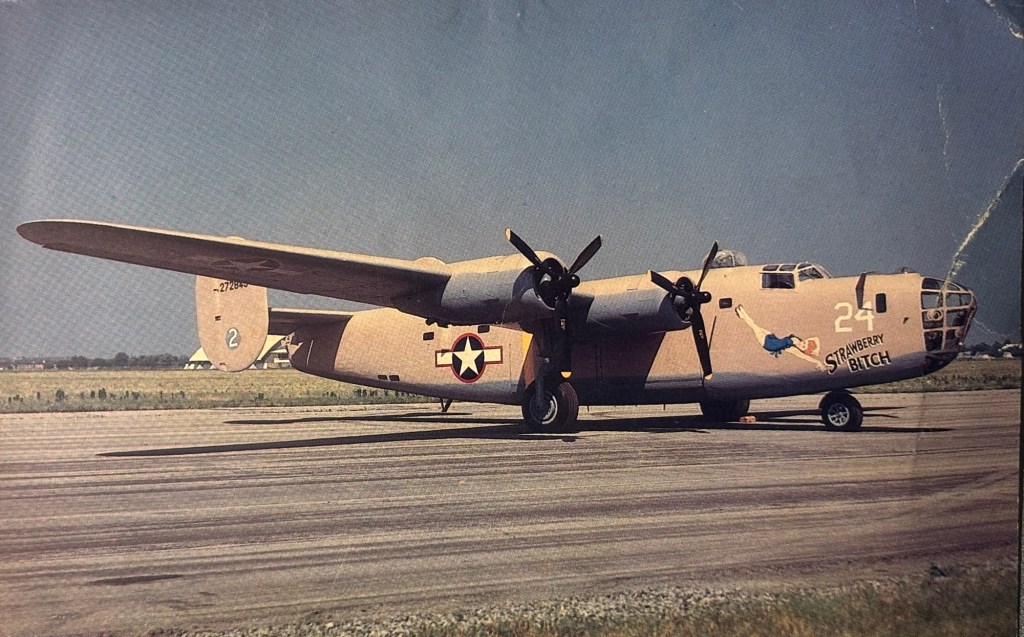
The B-24 Liberator. Daddy was a navigator/bombardier on one of these on missions attacking ball-bearing plants in Germany. The ball bearings were essential for the tanks the German Panzers were attacking European countries with.

I remember very little of what Daddy may have said about life in the POW camp. The two things I remember are that he hated the food and he and the other prisoners were constantly trying to escape.

People always asked, “Did you try to escape?”

Daddy always answered the same way: “We didn’t do anything else.”

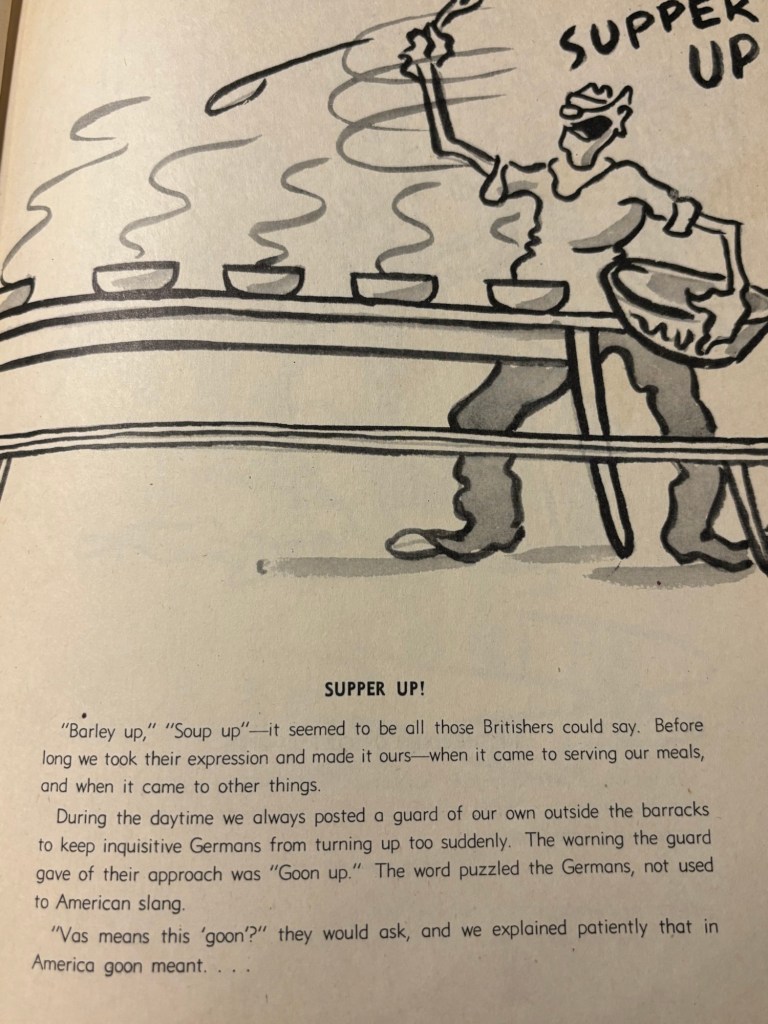
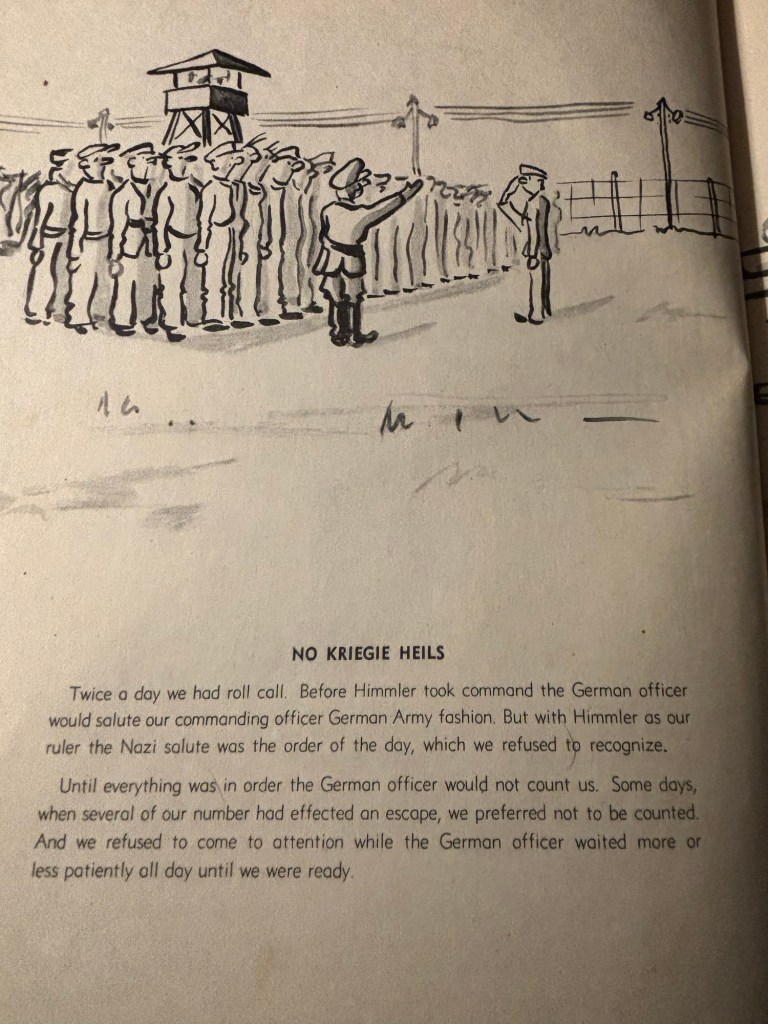
Cartoons from the book Welcome to POW Camp, which I mentioned in previous posts, bear this out.

A famous story, one my Daddy told us, from Stalag Luft 1: the day they finished the tunnel, climbed out, and found German soldiers waiting for them. Somehow they knew.

These cartoons provide a bit of insight into what life was like in the prison.

Solitary confinement was used to punish the POWs for trying to escape or being offensive to the guards.
Daddy would never eat sauer kraut or rutabaga, as I recall. Mom said it was because that was all he had to eat in POW camp. She said he only weighed 90 pounds when he got home.
Despite the harsh treatment and dangers, the POWs continued to resist the Nazi demands to “seig Heil” or salute Hitler while in the camp.

Probably the dominant thing that I remember from my Daddy’s few comments about the war and his POW time was his strong belief that the sacrifice and the discomfort were all worth it, because the dangers of Hitler’s Nazi assault on the world demanded that Americans step up and join the Allies to defeat him.

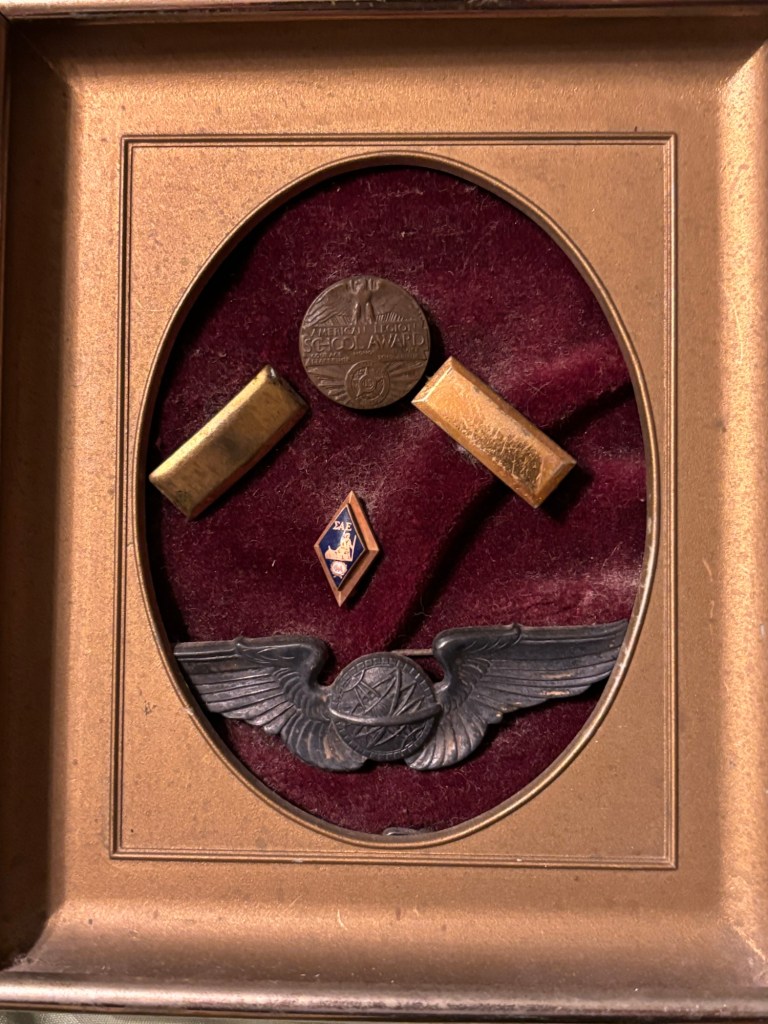
Daddy’s wings and lieutenant bars, plus a few other pins Mom saved.

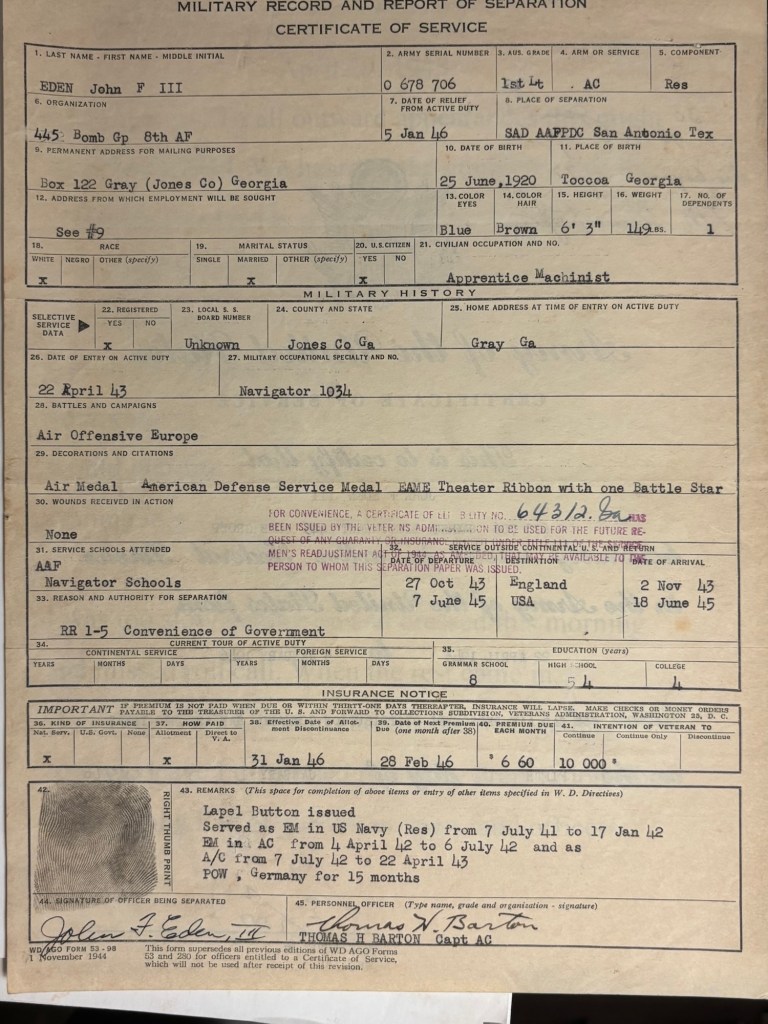
Daddy was awarded an Air Medal, American Defense Service Medal, and the EAME Theater Ribbon with a battle star for his service. As far as I know, he never displayed those or talked about them. I only discovered this list of medals recently when I found his discharge orders in some things of his that I’ve had for years.

The whole experience left him proud and dedicated to his life as a newspaper man, spreading truth in the world. It must have had serious effects on his health, as his heart started to go in his 50s, and at 66 he died following bypass surgery.

He was as good a man as has ever walked this earth, and he was equally kind and generous to everyone, regardless of their status. All of us, his children, have struggled to live up to the high standards he set.

And we still love, honor and miss him these 39 years later.

Captured

(This is the third in a series of posts on my dad’s experience as a prisoner of war in World War II. They are in the category Dad as POW.)

As he floated down to earth under his parachute, watching the B-24 he had just bailed out of burn and crash, my dad, J. Fred Eden III, decided he needed to discover what his purpose in life was. He was convinced that he had been saved from the explosion by God, and that God thus must have some purpose in mind for him.

But he was to have a lot of time to meditate on what that purpose was over the next year. He descended to the ground in the countryside near the German town of Freden – which he always found to be another indication that his presence there was no accident, as the name was his name condensed into one word.

The story of his capture is one of the few things that he repeated to us enough times that it’s pretty clear in my mind. It happened sometime in early 1944 I think, and it was certainly a dramatic moment. He was seen by the local Germans as an enemy and an attacker of their cities, and thus not welcome.

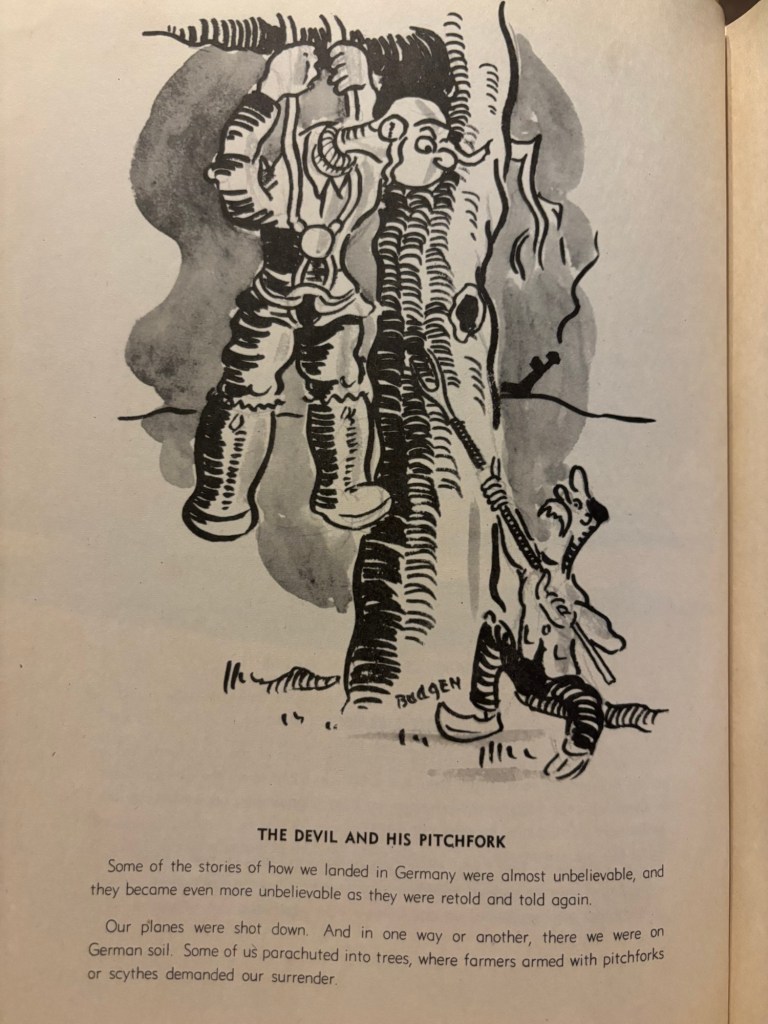
It was a rural town, so there were no soldiers on hand to rush out and capture the enemies falling from the sky, but the local farmers came out in droves, pitchforks in hand, to capture them. Daddy was surrounded and searched, and one of the frightened farmers found a pistol (I think it was a .45 automatic that all air crew members carried) in a pocket of his flight suit.

The excited farmer immediately pointed the weapon at him and tried to shoot him. Unfamiliar with the operation of the weapon, he didn’t know how to chamber a round and take off the safety, so, luckily for my dad and all of us descendants, he was unable to fire it.

Frustrated, the farmer threw the weapon to the ground and shouted in disdain, “Dum-dum! Dum-dum!” Apparently he thought it was a fake weapon.

A cartoon showing one way Kriegies were captured by the Krauts. This is from the book Welcome to POW Camp, and was drawn by Flt. Sgt. Budgen of the RAF, a POW at Stalag Luft Ein.

Daddy was then marched off to town by the contingent of pitchfork-armed farmers, and held by the local gendarmes until soldiers arrived to transport him to the “stalag luft” – the term for prisoner-of-war camps run by the German Nazi luftwaffe, or air force.

He was transported by train, as I recall the story, to the north of Germany near Barth. He spent the next 15 months in Stalag Luft Ein as a “kriegie” – the prisoners’ name for themselves that came from the German word “Kriegesgefangenen” – prisoner of war.

(Next up, life in Stalag Luft Ein.)

Welcome to POW Camp, Stalag Luft 1, Barth, Germany

was published by Edward’s & Broughton Company, Raleigh, NC.

No publication date is given.

The introduction says that there were 8,000 American Air Force prisoners of war in the German camp.

Among them were aces Col. Hubert Zemke (who shot down 28 German planes in air battles), Lt. Col. Gabreski and Major Beason.

RAF, Belgian, Russian and other Air Force personnel were also imprisoned there, according to the introduction.

Daddy goes to war in a B-24

(Second in a series on Daddy’s POW experience.)

My dad, J. Fred Eden III, joined the US Army Air Force in April of 1942 shortly after World War II began and flew with Eighth Air Force, 445 Bomb Group as a navigator on a B-24 Liberator.

His plane was hit by an anti-aircraft shell— ack-ack, Daddy called it — and he had to bail out. He ended up in Stalag Luft Ein in Barth, Germany, and spent 15 months there. 

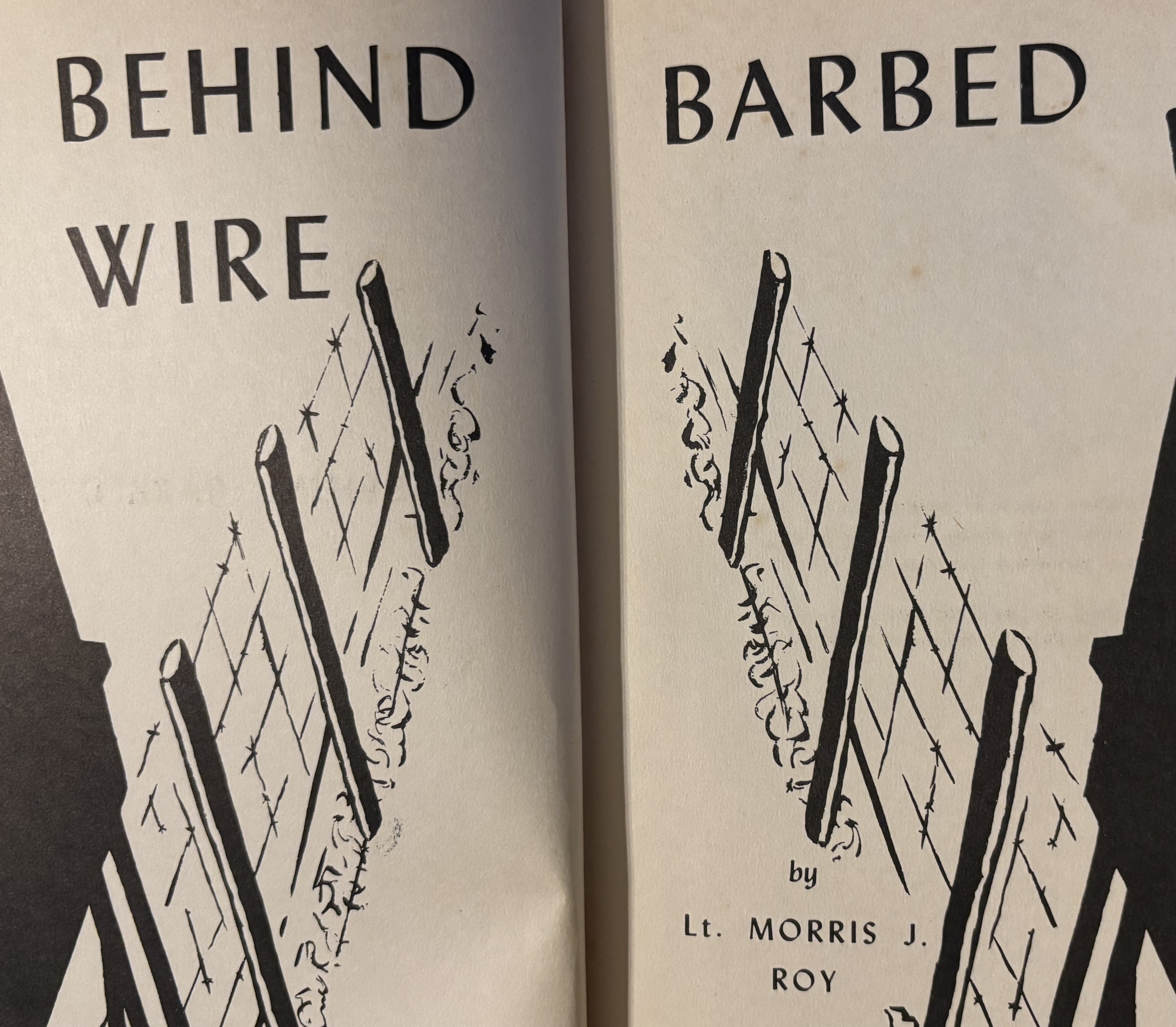
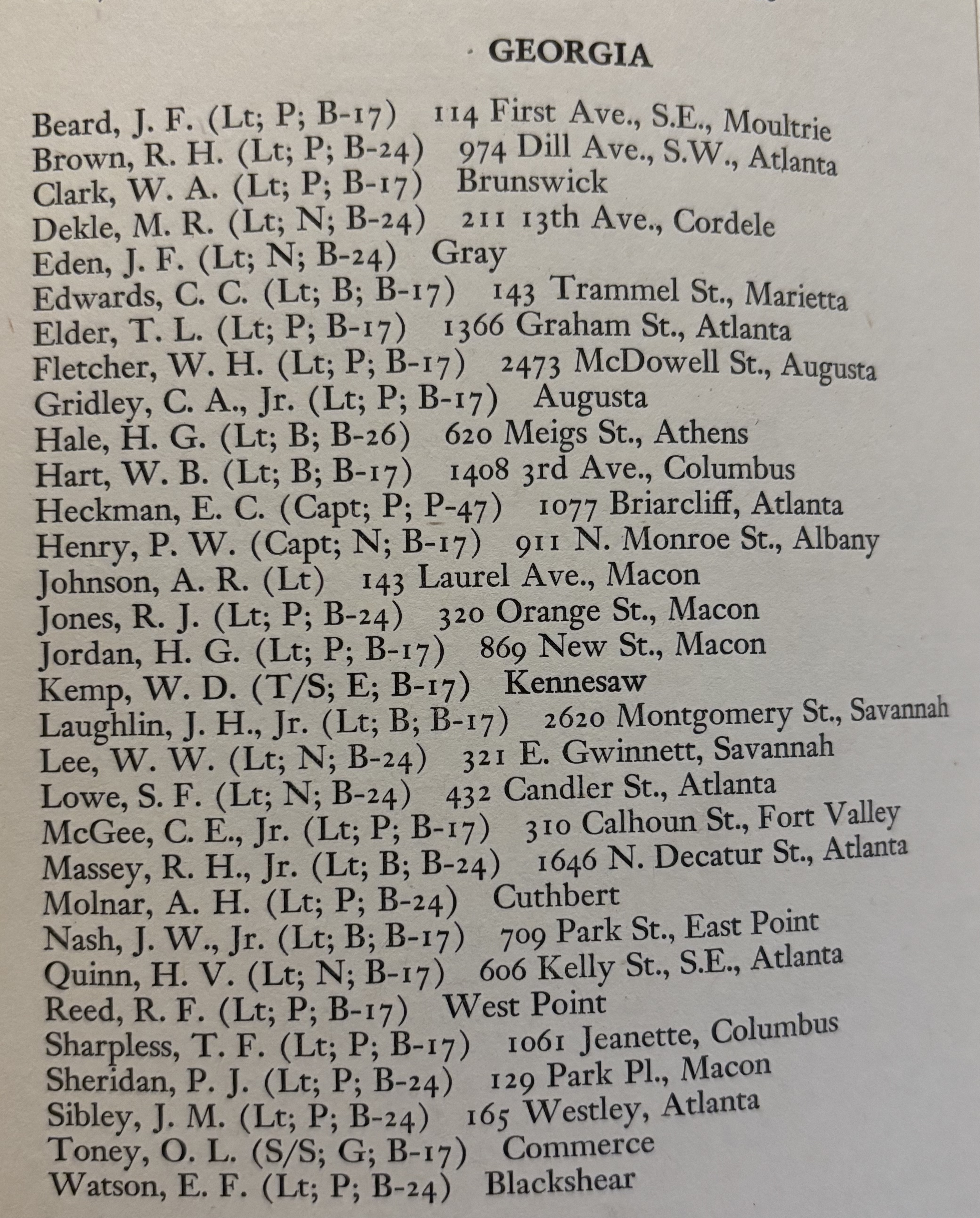
His name is listed in the book Behind Barbed Wire  by Morris J. Roy. 

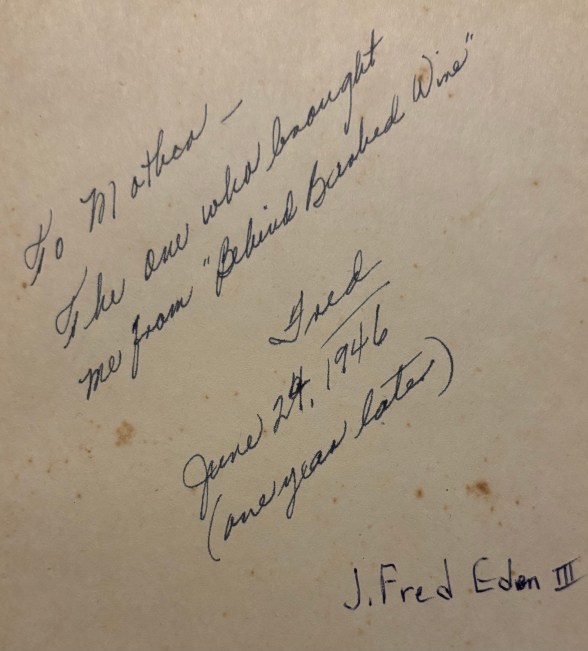
The dedication to the copy Daddy gave to his mother. Apparently a year after his return.

Daddy never talked about his war experience or the POW months very much, so my knowledge of all that is a bit sketchy, especially the time frame. But I know the general outlines of the story. 

I remember often how his hairline would rise as he watched episodes of “Hogan’s Heroes” or movies with scenes of the bombers similar to his… he laughed at the antics of the prisoners in Hogan’s group, and assured us that it was nothing like that in reality. He didn’t say much else. 

After Daddy graduated from Mercer University in Macon, he worked in the railroad shop there. When the war broke out, he signed up with the Navy as a pilot, but that was short-lived. He was in the Navy flight school from July of 1941 through January of 1942. The story he told was that he accidentally lined up to land on a taxiway instead of the runway during an instructional flight. His instructor said, “Son, we could teach you to fly, but we just don’t have time!” 

The demands of the war were intense. 

Daddy said when he got processed out of the Navy, he walked down the street directly to the Army Air Force recruiters’ office and said he wanted to sign up for whatever they needed, so he got sent to navigator school in B-17s, the famous Flying Fortress.

But when he got assigned to a duty squadron in England, they put him in a B-24. He went to England in October of 1943.

The process of navigation was the same for both aircraft, and he also served as the bombardier, looking through a sight and releasing the load of bombs at the right time to strike the target. His missions were strikes on the ball-bearing plants deep in Germany, a strategic mission to hinder production of the tanks being used in Hitler’s invasions of neighboring countries.

After only a few missions, Dad’s plane was hit, which was apparently fairly common, judging from the large number of airmen in his camp –  the Luft refers to airmen.

He said that his parachute opened, he looked up at the plane, and it exploded. I remember well this part of the story, as he always related with great feeling that at that moment, looking at the burning plane he had left mere seconds ago, he was convinced that God had saved him for some purpose, and he resolved to find that purpose and dedicate himself to it. 

That was the arc of his life! 

The son and grandson of Baptist ministers who taught and worked at Mercer, he realized that his pulpit would be a weekly newspaper rather than a church. He spent his life in pursuit of that dedication. 

An interesting book of cartoons and text by prisoners in Stalag Luft Ein.
The listing of prisoners from Georgia in the north compound… Daddy is the fifth name in the list.
The title page of the book.

The dedication at the beginning of the book.

Daddy was a POW in WWII

My Daddy as a POW—

This image is the cover of a book of “Kriegie cartoons” — drawings and text by prisoners in Stalag Luft Ein, where my dad was a prisoner for 15 months during World War II.

I am hoping to begin a series of posts on my Daddy’s experiences as a POW during WWII. 

Several of his grandchildren have expressed interest in learning more about this story, which he rarely talked about when he was alive. He did leave a journal about the experience of being released, and there are several books that fill in the details of what life was like for a prisoner of war in the Nazi prison camps. 

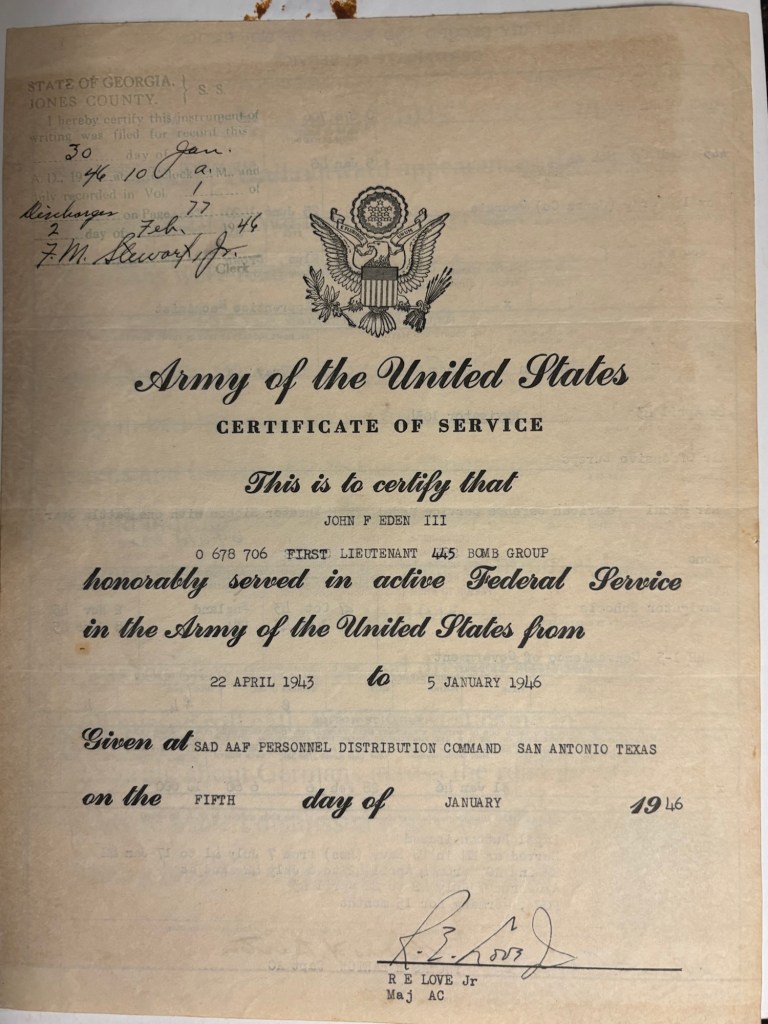
Daddy’s certificate of service
DD214– his discharge papers.
The dates of service including his 15 POW months.

Please leave a comment if you visit these pages!

Anna June Spring ‘24

April 2024

Ah, where to begin! So much going on with this girl I don’t know what to talk about first!

We had a great visit with JohnJohn at the Union Station back in March when some of our friends were playing there, and June just loved seeing him and hanging out with the kids at the Station. She wants to go back every weekend! She was very well-behaved, though I had a little bit of a hard time keeping up with her in the crowd. But she was not intimidated at all and didn’t cause any problems. She played with a group of mostly older kids around inside and out in the courtyard. She can hang with the big kids!

Her conceptual development continues to amaze me. Last month, she asked me, just out of the blue, “But Dad, who made God?”

I tried to answer that in a way she could understand, saying basically that no one could really answer that question, but there are different ideas about it. I refrained from trying to explain that we can’t rule out an infinite regress of causation…

She also asked me who was the first person. Also hard to answer. She’s constantly questioning! Those church folk are not likely to be successful at indoctrinating her!

Lots more to journal, as life goes on in stressful, joyful and unexpected ways! But focusing on June is what I’m about here! She’s with me at least five days a week, sometimes more, and we are getting on very well. I almost never need to resort to threat of punishment to get her to do what I’m asking her to do, and she’s almost always a very happy kid!

We do lots of activities, scooter rides to the park and playing in the yard, plus games inside. She loves hiding eggs — we’ve been doing that since a few weeks before Easter — and hide-and-seek, musical concerts, and lots of reading.

As we approach her sixth birthday and the end of Kindergarten, her reading skills are developing rapidly. She loves reading the Accelerated Reader books with me, and most of them she can read through with no help on the second or third read. She’s made 100s on all of them so far. It’s really fun seeing her decode and learn to read with expression.

She still just loves to talk, and it’s sometimes very entertaining, though late at night it’s annoying! Her vocabulary now includes words like “eventually,” “obvious,” “similar,” and “solution.” Are these Kindergarten words?

She calls me “Dude” or “Bro” sometimes now. But sometimes, she still likes to baby-talk. And she tells me she loves me every day!

She is totally amazing on the scooter! She can go so fast and make tight circles with both feet on the board, which she calls skateboarding—she met some skateboard kids at the park and got to try out a real skateboard. We do videos often for Granny!

She’s going on her third boat ride with her friend Ember today, and she loves driving the boat!

We’re really looking forward to our trip to Dixie next weekend! She needs to know all her cousins and other family! Should be fun!

LittleJohnnyIX

(Another installment in the series of stories I tell June from my childhood.)

A visit to Granmunnie’s house

When Little Johnny was about eight or nine, he would ride the train, the Central of Georgia, from Adel to Macon and go visit his grandma—he called her Granmunnie—who lived in Gray. (Georgia Gray, as Johnny called it.)

Johnny got to ride the train because Granmunnie’s friend Mr. Green was a conductor, and he helped look out for Johnny on the trip.

Granmunnie lived in a big two-story house right in the middle of Gray, and worked as a social worker for the welfare department in Jones County. Johnny loved the house, though the upstairs, especially the room that was always locked at the top of the stairs, was a little scary. One day he climbed out the window of the landing onto the little porch roof and slipped down to look in the window of the locked room. He was kinda disappointed, though, because there was nothing but boxes and trunks and old manikins and piles of clothes in the room. No skeletons or ghosts or anything exciting!

He also loved going to work with Granmunnie at the courthouse annex, but the “trusties” who did yard work and janitorial work around the courthouse were a little scary too in their blue and white striped uniforms.

Johnny would get to ride with Granmunnie to visit some of her clients out in the county, and they would often stop at a peach orchard a friend of hers owned and she would walk out into the orchard and pick a few peaches and then she and Johnny would sit in her old 1940s Chevrolet and eat them.

They would visit a man who lived out in the middle of a pasture in a little shack he had made out of old signs and cardboard boxes, and a family who lived in an very old wooden house that was teetering on top of piles of rocks on a little clay hill. Johnny would try to talk to the kids who were sitting on the rickety old porch, but they never said much.

Sometimes while Granmunnie was working in her office, Johnny would go into the little county library that was in the same building and lie on the couch and read. He loved reading books about dogs, like Big Red, and one of his favorite characters, Augustus, and he even read some adult mysteries, including a lot of Perry Mason stories. (The Darby Trial was one mystery, which he read because he thought it was the Darby ‘trail’ not ‘trial,’ and he didn’t understand much of what was going on in it!.)

He and his Granmunnie had lime sherbet with Bubble-Up almost every day after supper, and Johnny still thinks of her whenever he sees lime sherbet.

Granmunnie’s house had a closed well on the back porch, but she never drew water from it. There was an old shed and a storage building in the back yard, which was all bare clay with a few oak leaves scattered around, and Johnny would get a rake and run around the back yard pulling the rake behind him to make tracks through the leaves.

There was also a very old, one-room house at the very back of the lot, just across an alley that ran through, and a woman who occasionally would cook or clean Granmunnie’s house lived there by herself. The old house had an open fireplace in it and the woman did all her cooking in the fireplace. Johnny remembers the way the house always smelled like wood smoke, because there was always a fire, even in the summer.

There was an old, old car in the shed that Uncle Dan had bought when he was young—maybe it even worked—and Johnny loved to sit in it and pretend to drive. It had wire wheels and no top, and Johnny thought it was just about the coolest thing he ever had seen!

The house was very mysterious to Johnny, because there were doors at several places outside that went under the house, which was higher off the ground than Johnny was tall! The whole thing was surrounded by old rusted iron fences that had very decorative, pointy things at the top of each post and gates that opened up into the alley at the side of the house.

When the visit was over, Granmunnie would drive Johnny in to the train station in Macon for his ride back to Adel. She always packed him a nice little lunch for the ride, and he enjoyed looking out the window while he ate.

One time, he had just finished his lunch when the conductor came through with a large garbage can calling out to the passengers for trash. Johnny wanted to get his lunch bag into the can, so he quickly rolled it up and tossed it in.

Just as the conductor pulled the trash out of the train car and started across the clattering, scary platform where the two cars were hooked together, Johnny realized that he had forgotten that in the bottom of his lunch sack were about four of his favorite cookies—Nabisco sugar wafers—and he had just thrown them away.

He was so disappointed and sad that he almost cried when he realized the cookies were gone. But it was too late to chase down the trash and get them back! Little Johnny remembers that trip—and his Granmunnie—every time he eats sugar wafers!

Little Johnny VIII

Little Johnny and the grease trap

(A very funny one in the Little Johnny series, stories I tell June from my childhood.)

Once upon a time when Little Johnny was about four, he had a very embarrassing experience—one of quite a few, as he was a bit of a showoff as a little boy!

Johnny and his family were all visiting Aunt Sadie and Uncle Andrew in Pidcock, Georgia, one summer weekend, and all of Johnny’s many cousins were there, the McKinnons who lived there—Billy, Mabbat, Wallace, Phillip—and Patsy and Marilee, and Barbara and Little Bill, and maybe a few more. It was one of those family gatherings that happened a lot down in Brooks County.

So they were all playing outside that day, which is what they mostly did wherever they were, and Little Johnny decided he needed to show off a little bit.

“I bet y’all I can walk all the way around the top of that grease trap!” he boasted, knowing everybody would be impressed because nobody wanted to even get close to that grease trap most of the time. It was stinky and yucky and scary. It was just a little brick wall about a foot high that made a pool just underneath the kitchen windows that caught all the dishwater and trapped the grease (hence its name!) from all the dirty dishes instead of running it through the septic system where it tended to clog up the pipes and the drain field. But it was yucky!

So everybody poo-pooed Johnny’s boasting, saying they knew he wouldn’t get up on that wall and walk around it cuz he would be in big trouble!

Well, that was about all it took to make sure that Little Johnny was gonna do it, since they dared him.

Well, he stepped up on it, and they all gathered around oooohhing and ahhh-ing and taunting him even more. So off he stepped on his daring journey around the little wall. Except that about three steps into that journey, his foot slipped on that old crumbly brick and down he went, Plop! right into that stinky, greasy, yukky mess!

Of course, he started yelping right away and somebody went running off to get his mommy and he was trying to climb out when she arrived.

She was not very happy! She mostly just snatched him out of that mess and marched him around to the back steps by the ear.

“Stand on those steps!” she ordered.

So Johnny stood on the steps while Mommy hosed him down good with the garden hose, and she wasn’t too delicate about it either. She finally had to make him strip down to his underwear to get him halfway clean, and then she marched him into the shower—luckily, there was a shower room right off the back porch, because this was a country farm house and being dirty was pretty normal.

Johnny was not happy about getting hosed down, especially with all his cousins standing around laughing at him and taunting him for being such a showoff.

But we all hope that Little Johnny learned a good lesson from that grease trap! He sure did stay away from it for the rest of his childhood!

Little Johnny VII

(Another installment in the stories I tell June from my childhood and youth. This is a re-telling of one of her favorites – it’s also in LJ II along with the bike ride story.)

Little Johnny and the trestle

Once upon a time when Little Johnny was a teenager, he was driving his Daddy’s station wagon (that old 1956 black Ford) around in the countryside in North Carolina with some of his brothers and his sister and their friends when a scary thing happened.

They were just out “riding around” as they liked to do, but it was in the country around Lake Junaluska, and Johnny didn’t know much about the roads up there, since they were just visiting their friends during the summer. Bunny Anna, who had spend most of the summers of her life there, at least a few weeks every year, knew the area and she was helping Johnny know where to go on their ride.

One of the nicest drives around was old County Road, and they were just cruising along it when suddenly Bunny Anna said, “Oh look, here comes the trestle, speed up Johnny! It’ll be fun!”

So, of course, Johnny speeded up. Maybe a little more than Bunny expected! Because she started yelling, “No, no, slow down, I was just kidding!”

Well, Johnny tried to slow down, but it was a little too late, because he was going a little too fast and when they went under the trestle, he discovered why Bunny was yelling.

On the other end of the trestle, County Road made a pretty sharp right curve, following the mountain, as those mountain roads tend to do, and Johnny was going a bit too fast for that curve. He was wheeling the old station wagon around and putting on the brakes as hard as he could, but the car drifted right on across the left lane and onto the shoulder of the road! Johnny could hear the tires on his side of the car roaring in the gravel on the shoulder, and that’s when he looked out the side window. There was not much shoulder there, just a very steep bank down to the little river that the road followed, and lots of rocks and scary stuff.

Johnny was hanging onto the steering wheel and trying to keep the car from running off the road, and nobody was saying anything—they were all holding their breath and covering their faces to keep from screaming. It was lucky there were no cars coming the other way, and after a little while Johnny was able to slow down and get the car back onto the road.

He pulled over into a pullout on the cliff side of the road and stopped. Then everybody in the car started laughing and talking and being really happy that they didn’t just die, but Johnny’s sister, Linda, was so scared that she didn’t really like all that laughing. She was a very sweet, very good little girl, but it really upset her and she yelled out at everybody, “Y’all stop your damn laughing!”

Everybody got quiet all of a sudden, because they were all so shocked to hear Linda say that! You could hear some of them whispering, oh wow! Linda cussed! I never heard Linda cuss! and things like that. And then everybody started telling her how sorry they were for laughing and that she was right, they shouldn’t be laughing because they did almost just die!

After everybody calmed down, Little Johnny drove them all back to Junaluska, but he drove very slowly! After a while, they all kinda started talking again, but everybody was talking really quiet now, and finally Johnny told everybody how sorry he was that he scared them, and Bunny told everybody how sorry she was that she suggested for Johnny to speed up, and everybody kinda go over, but they never forgot it!

AnnaJune Fall 23

The children

Summer-Fall 2023…

Me and June

Well, it’s been me and June a lot since the beginning of the summer. She’s spending lots of time with me, tho Mommy’s not here much, and we’re getting on well. Her birthday was fun, and she’s very proud to be five — tells everyone she meets that she’s five.

And boy is she five! She has such expanded ideas about things these days, and it has been very interesting and sweet watching her learn about a wide variety of things since she started kindergarten. She has a great kindergarten teacher, Mary Frye, and she usually is very excited about going to school, tho as the year is progressing, she is getting less eager to go.

She’s also just generally expanding her awareness of life — sometimes it’s disturbing, as she has said to me several times that she doesn’t want me to die. She was also playing pretend about someone dying and asked me frequently about my brother Bob’s death. Gene’s death (June 27) has been very hard on her, as well as on me. I think the reality of Taylor’s mom’s early death and these two uncles dying has made her especially sensitive and aware of the subject of death.

I wrote in my journal soon after Gene’s death, “I guess June keeps me going. She’s very loving, though stubborn, and so aware. She asked me yesterday if I was going to die in a long time or a short time. I told her I didn’t know, that no one knows. Gene’s death is a big factor in that, I guess. We tried to prepare them both, but kids don’t really understand. Just that someone’s gone.

“I do worry about her dealing with my death, but I think she will be okay. She’s strong and very self-reliant. I just hope she remembers how much I love her!”

We got a kitty and she is crazy for that cat! She doesn’t really know how to be nice to it, tho. Just treats it like it is a stuffed animal. Luckily, the cat is very tolerant!

June and I rode to St. Simons together to visit with Linda and John, and Stewart and Julian showed up with the little one, Charolette! June loved being with everyone!

She would really much prefer we were all together, so this back and forth life is hard on her. She’s with me about four days a week, usually, and then sometimes more, as Taylor stays over occasionally.

Taylor texted me one day to say, as part of a long and involved message, that “Anna June says she has the best Daddy in the world. And she’s so proud of you…” That meant a lot to ole Dad!

One of the most amazing things she’s said to me lately was about black holes, which I included in Little Johnny V – I had told her a story about crashing on my bike as a kid, and she said, well, you have to careful not to fall into a black hole because they suck up everything that falls into them!

I was astounded and asked her further, discovering that she had learned about them from some YouTube thing, but she didn’t realize there were not any on the Earth. So we talked further. Then she asked me, “But where do things go when they fall into a black hole?”

I said, when I got over being amazed, that no one knows the answer to that and lots of scientists are trying to figure it out.

The list of amazing things she says has gone beyond keeping up with it! And she’s doing so well in Kindergarten! She was in the paper twice for being in the student’s of the month for the Leaders in Me program, and her diagnostics are really good for the first half of the year. She can read lots of stuff and is very into learning more reading as well as the phonics. She enjoys seeing the words in the stories that she almost knows by heart and realizing that it’s the word that says… whatever it is. And she loves sounding out the words she doesn’t know.

Her math skills are pretty amazing too! She can “subatize” so well! (I just learned that term, which means recognize how many things are in a group without counting… something like that.)

She loves playing dice, and I think it helps her math awareness.