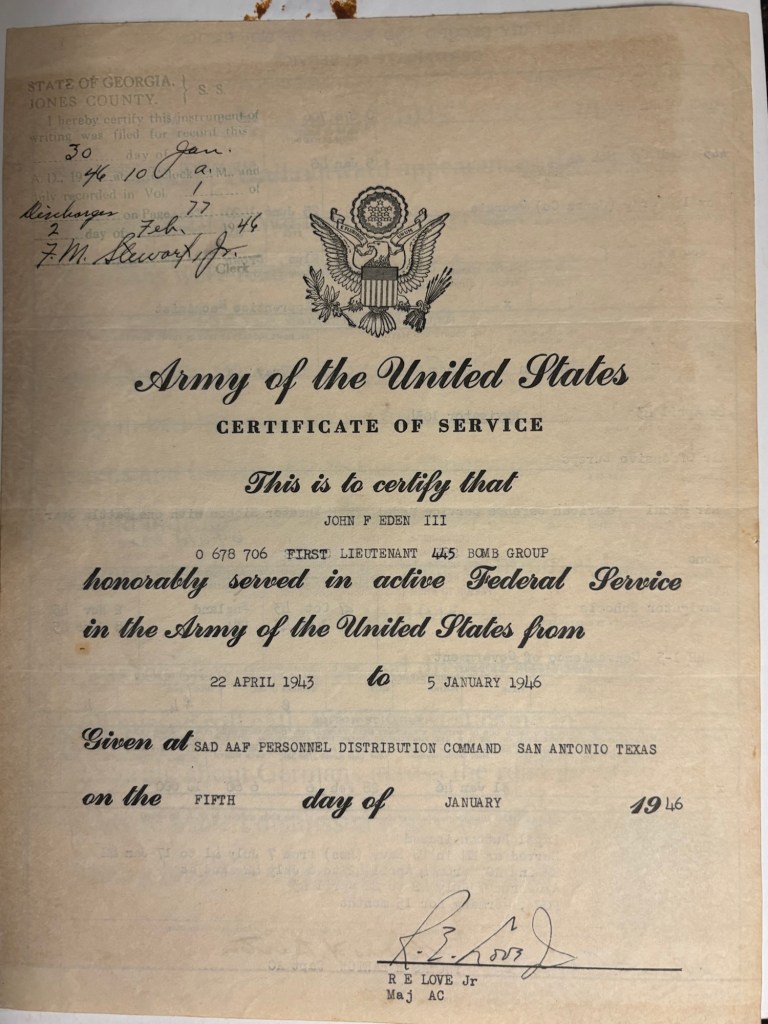
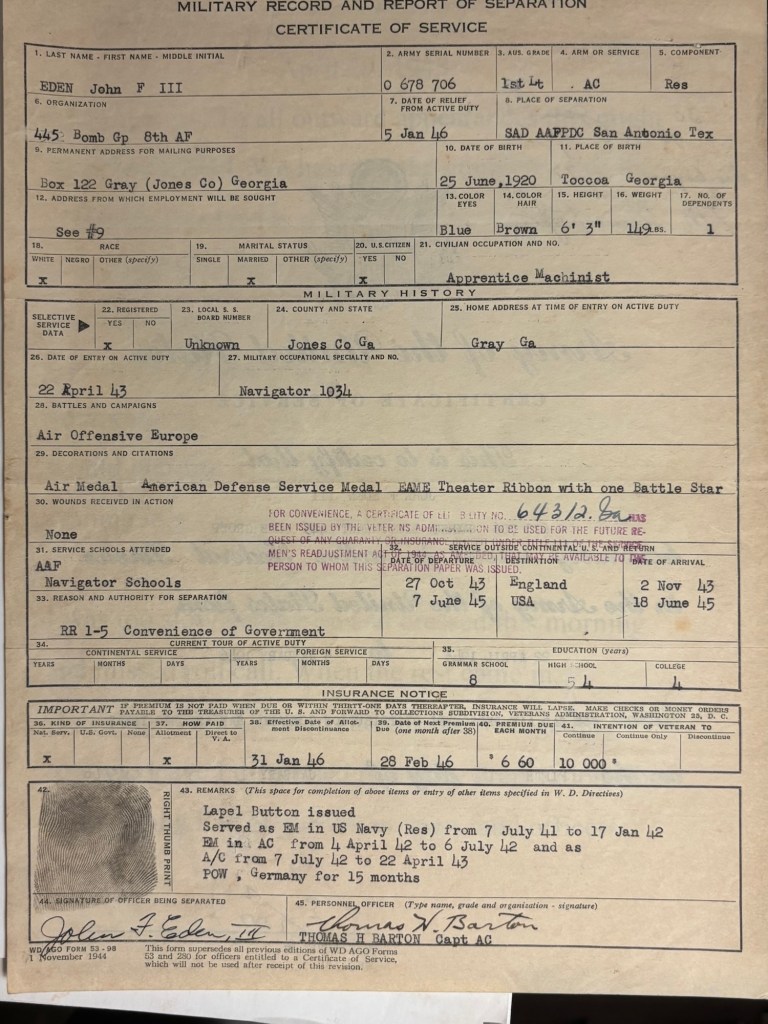
J. Fred Eden journal of POW liberation in 1945
[This is from a fragment of Daddy’s journal that Mom found after his death. Our friend Harry Yeomans transcribed it for her and provided us with copies. Thanks Harry!]
April 29, 1945
Only rumors. To all outward appearances, this might have been 1944. We heard in the grapevine that the Germans were ready to move – if the Russians came any closer. But we also heard that we were to be evacuated at the same time – as POWs.
Lay in bed listening for rumbles, planes, or air raid sirens and looking for flashes, flares – anything that would indicate that someone or something was coming to get us out of this – state-of-mind, at least!
April 30, 1945
I was too slow getting up and getting dressed this morning and missed roll call. When the rest came in, jabbering about Germans across the road getting ready to leave, I dismissed it as only preparations, but when a long line of guards, women – and officers pulled out, it seemed true. They were at least beginning to leave. After breakfast Sheridan came in with news that G’s had given permission for us to dig foxholes, and that the instructions were on the board.
What did this mean? Who have we to fear? [We] walked over to watch the Krauts leave – the Sgts were digging like mad – like a bunch of moles.
Across the fence all that remained of the Krauts were in confusion, like an anthill when hot water is poured on it. Tiffany’s “girlfriend” (whom he had seen and approached) was striding about in her little boots and trench coat, blond hair flying in the Baltic breeze – a guard came by – amused at all our digging. “Zwei Tage-alles gegangen” – in two days we’ll all be gone!
Strolled back to the barracks – boys from room digging trench. After all, these Krauts might get mad and strafe the place, so I got a Klim can to help dig. About that time there was a terrific explosion – Bombs! – no, it was in the flak-school – demolition! This goes on for hours, accompanied by explosions from the airfield. How that huge building stood, after all the HE around it, defies explanation.
We dig our slit trenches just in time for the biggest blow-up of all – an ammo bldg. “We thought we’d had it!”
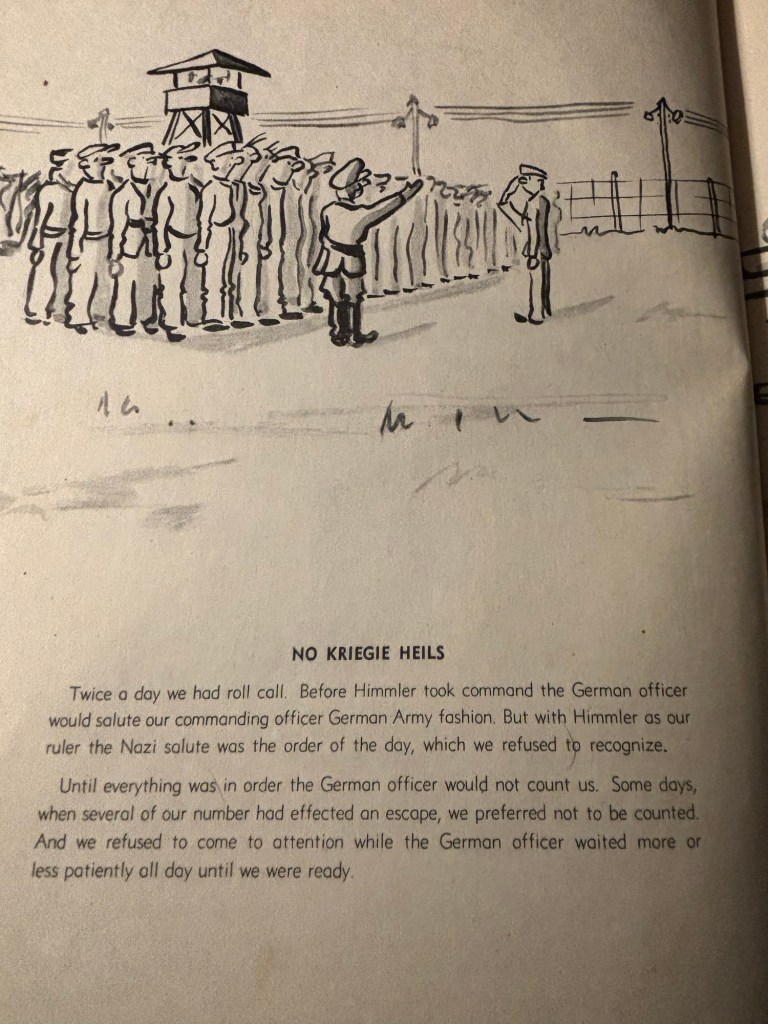
Roll call at 1600 was a farce. Several big explosions as Major Steinhauer goes thru the motions of counting.
It’s rumored the counters are all that’s left – with about 40 interpreters. There are still Krauts in towers, but no guards in compound for roll call.
This day is down in my memory as Kraut Panic Day. They have left in a hurry. The refugees from town are loading the Red Cross parcels we have stored at the flak-school. Details went over to help get parcels out. The few guards left are trying to hold them off – not wanting to shoot, but they are pretty determined, grabbing the ones we get.
Hundreds have left Barth, afoot, ahorse, on cycles, by boat – anyway to get out! They are “fleeing in confusion.” All this excitement in contrast to the deadly inactivity of the last weeks is almost too much. The Reds must be a lot closer than Berlin says they are – East of Ankleeve – i.e. about 60 mi.
The last thing I heard before I went to sleep – “When the Krauts turned off the lights the picked up their packs and left.”
I don’t believe it. I’ll have to see it – maybe someday.
May 1
At 0530 I was rudely awakened by a messenger from Al [daddy’s A/C commander and pilot], who I found was in the Volage – waiting to go on guard in the towers! There are Americans patrolling the fence. Americans are in the towers – we are in charge! It’s like being drunk!
At 0030 the Krauts turned it over to Col. Zemke [a famous US pilot, Col. Hubert Zemke was credited with shooting down 28 German planes in air battles] – at any rate, they left it in his hands!
For the first time, we listened to BBC. No mention of us except Reds are at Auklam and Neustrelitz. The bulletin board reported by noon that 1) there was a Russian liason officer in conference with Col. Zemke; 2) that a Russian spearhead was 3 km south of Barth “proceeding slowly up the road.”
We stood at the south-most end of compound. Looking – straining to see first tank. All we could see was all kinds of refugees, forced-labor POWs, etc. coming to this camp.
The Russian liason officer was found to be fictitious, but at 2225, while we were listening to Hit Parade, the Russians did come! Too dark to see anything, but the Tannoy announced it true – 5 minutes later, the Hit Parade was interrupted to announce, “Hitler is dead!” Somebody beat us to it.
Then to top it all off – “Don’t Fence Me In” sung by Lawrence Tibbett was first on Hit Parade.
Boy, what a climax! We are freed men now – after 14 months and 11 days.
May 2
Turns out the “Russian spearhead” that reached here last night was a private with two tommy-guns and a dilapidated truck. But he has been reinforced by several other trucks of Reds.
At 1400 Col. Greening call us out. “The Russian colonel in charge of the advance unit is in Barth now, has ordered us to be ready to walk out of here in six hours. Get everything in readiness. We may not move, but we must be ready.”
There was a mad rush to get packs made, warm clothing on (it was a chill, murky day), blankets rolled, etc.
As we scurried around, there was a wild shouting from N-2 and N-3, and to my – well, amazement – I saw Kriegies tearing down fences, tipping over guard towers, streaming down the roads – running wild.
I stood watching agape for a few minutes – til I recalled the urgency of the need to get my belongings packed.
It seems Colonel Chekov – bandoliers, pistols, and all came riding in to liberate the Kriegies, and finds us still behind barbed wire, so he orders the fences torn down.
“You are freed! Go to town! Tear down the fences! I have come to liberate you!” was the gist of his speech. To keep on the right side, diplomatically, of our allies, Zemke thought it feasible to comply and so gave the orders.
A few minutes later, we heard that there are German packs over at the flak-school, that everybody is going over to get them. That sounded like the very think for packing my stuff if we had walking to do. I grabbed a coat and ran with the crowd toward the school. Hundreds were streaming toward it, other hundreds were streaming back, laden with all kinds of stuff – hats, helmets, packs, jackets, souvenirs of all kinds. One man that I vaguely recognized in the confusion was returning with the prize of all prizes – a genuine, unopened, untouched egg!
The next few minutes I shall never forget! I had supposed, and had often cogitated upon it, that the day of liberation would be a wild, maniacal one, but even in my wildest wanderings, never had I imagined the things that I saw happening at that flak-school.
The school is a huge affair, brick throughout, built and equipped to do credit to an American college. Offices, rooms, and classrooms occupy the first two floors, and the attic floor is used for warehouses. The whole is surrounded by garages or storage houses forming a side street or court around them. This was filled with equipment blown up by the Krauts before they fled.
I have read and seen movies of wild armies looting and mutilating, but I never expected to see Americans in the role. From the time I entered the court til I left sometime later, I saw thousands of at least half-crazed Kriegies breaking windows, kicking in doors, grabbing everything in sight – not particularly needing it, just taking it because it was there for the taking.
I wandered frenziedly from one room to the next – looking at first for “those packs.” Then the necessity for hast gripped me, and I began to half-run through the mazes of equpment in the attic storehouses, through bales of hats, shoes, fur helmets, fur gloves, socks, fatigue clothing – it seemed a nightmare.
Everywhere there were outlandishly garbed men, groveling on the floor amidst the stuff, searching for more prizes to add to piles of stuff already too large to carry.
I wandered through, it seemed, miles of equipment and still no packs. I gave up in despair and went to the second floor. Things weren’t quite so wild there, and I began to quiet down. I found that all I had collected was a dilapidated old German O’seas cap, two bundles of fur-lined flying helmets, and a pair of giant-sized mattens.
In disgust with myselt, I flung away the cap and mittens and gave away one bundle of helmets. The other I kept for the boys to wear on the hike.
In an office I was passing, I noticed a bevy of maps, scattered all over. I glanced through them hurriedly for one of
Barth, but all had this section cut out. I stuck a “fligerkarten” of East Germany in my pocket.
Rushing on, I came across a room with several books on desk – one was a Wehrmacht song book that for some reason I took.
In another place, I came across an English book that I carried for at least an hour. In another building, of which the door had been battered down, scores of fellows were streaming out with service caps and blouses jammed on. In the confusion inside, I saw all kinds of band stuff – bass drums bashed in, horns broken in half – I left. In short, I never found the packs, returned to the barracks. Poop is that we won’t move, but must be ready.
Peacock had been to town, returned with descriptions of a wild, dirty horde of looting, drunken Russians on horses, in carts, in Jerry autos – all hell-bent for election. Some generous American had given him a drink – of green ink.
That evening Shorty and Tiff went into Barth. A Russky gave ‘em a cup of vodka and Kirk came back pretty high, talking a mile-a-minute about the Cossacks – storming through Barth on Jeeps, half-tracks and trucks. By the time we went to bed around 2 a.m., I still didn’t know whether we were free or not. It seemed so peculiar the way the Russians gave orders – for all I knew we are now Russian prisoners.
May 3
Col. Zemke spoke to us at midday to help clear up the situation somewhat. It seems that the first Russian units (Kurds) had orders to evacuate all POWs, internees, forced labor, etc. The Commander gave orders for us to move out. He was pretty drunk too, which helped. Now the new Commissar in Barth had changed the orders. He ordered us to stay here. That if we ran out of food, “I will provide.” In short, he wanted it understood that he was boss and that he meant to be obeyed. Zemke said he sent men to Sweden and to our front lines “three days ago,” that the Russians had notified Moscow, who would notify Washington, who would notify the Eighth Air Force, etc.
“I fully expect to have you flown out of here.”
All of which sounded good – in a way – but which meant exactly zero.
Things have changed a lot around here, though. Kriegies have horses, bicycles, cars, chickens, geese, cows, eggs, meat – in fact, Al got me over to his new quarters (the former German guard barracks) to help him roast a chicken. We topped it off with some macaroni and spaghetti sauce. What a meal!
We’ve had four Red Cross parcels issued this week in a “get ‘em out to the troops to keep from loosing them” policy. So there is beaucoup food.
Zemke’s idea is to keep us strictly in camp. He says Russkies are trigger-happy. That by various means we have had seven men killed so far. But there are plenty who left with the guerrillas, or advance troop, last night. None are taking off today.
May 4
Still plenty of milling around and general confusion. Nobody knows nuthin’! Official announcement that Eisenhower orders all POWs to quote, “Stand by!” unquote. This was a good signal for the guys to leave by droves, disgusted with the situation – with the merry run-around we’re getting after two years of “standing by.” This sure makes Air Marshall Tedder and Gen. Doolittle’s statements look foolish. “Will have you out in 72 hours.” We’ve been counting pretty heavily on that I guess.
Lay out on peninsula watching guys paddling across the inlet to leave for Rostrock, Lubeck, Wismar – or anywhere to get out of here. They say the Limeys are flying them out of Wismar every hour. Also watched Russky hordes – carts, wagons, calvary, kiddy-cars – start toward Zingst. What a wild, mad lot! They don’t travel on gasoline, but on vodka.
There have been four concentration camps found in this area. Some of the truth about these places is blood-chilling. Grown men who weigh 70-80 pounds – living on a slice of bread and bowl of Jerry turnip soup for 6-7 years. Typhus, all kinds of horrible diseases – phew.
And the Krauts expect mercy. Lord, see that they get their just and due punishment.
Manure and maggots knee-deep, live men insensible to the fact that there are dead bodies lying beneath them. A British paratrooper 37 months in dark, in solitary, with only one thought left in his mind – “I wanta go to town.”
They’re dying like flies, can’t be fed, except glucose, can’t walk – uhhhh!
May 5
First part of day much same. General confusion, milling around. War seems about over, with Krauts giving up by droves. At 1615, a Jeep, a Major, a Captain, and S/Sergeant arrive from somewhere.
General Aristoff, local commissar, confers with Col. Zemke. Col. Moss from Gen. Bridges of the 9th Something arrives “to conduct evacuation.” Russians refust to recognize his authority without credentials. Current idea is that we’re waiting for big liberation stunt to be pulled by Marshal Ratakoffsky and “Monty.” Would be quite a deal, but don’t know as how I care to wait – just for the publicity. Lots of things more important to me right now.
Scores more leaving for somewhere. Al says MP’s bringing them back by scores too. So it may not be such a good deal after all.
Guard squadron had fresh meat for supper. Some guys really got a break out of this mix-up, but thousands of us are still where we started – just Kriegies in a little larger compound now.








 Shunyata's Apprentice