Life as a POW

After my dad had to bail out of his B-24 and was captured by German farmers near Freden, he was taken to Stalag Luft Ein, a prisoner-of-war camp for Allied air crew members. He was one of some 8,000 POWs — Kriegies they called themselves — at the camp near Barth in northern Germany. He spent 15 months there, only leaving after the Russians came through near the end of the war and liberated the POW camp.

Daddy’s 8th Army Air Force insignia.

A member of the Eighth Army Air Force stationed in England, Daddy always said that Jimmy Stewart, the famous actor of early 1940s, was his commander. I haven’t checked on that, but I do know that Jimmy Stewart signed up when the war began to express his patriotism and fight the Nazi threat. Daddy didn’t talk much about the whole experience, but he was proud to serve with the famous Stewart.

My sister remembers that Daddy told a story of Stewart borrowing his flight jacket once for a photo op! Daddy’s claim to fame, she says!

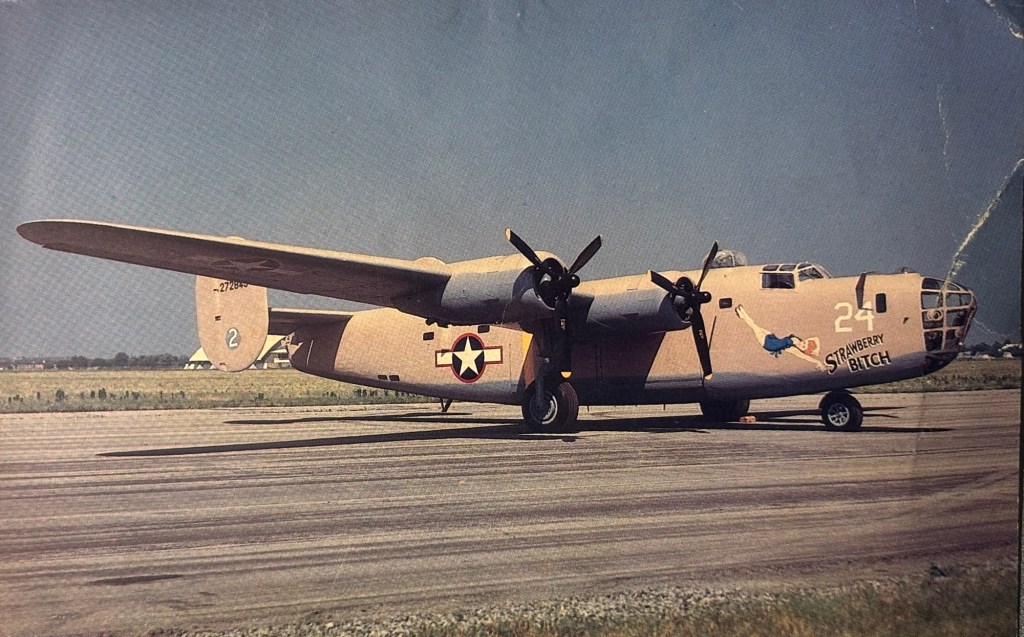
The B-24 Liberator. Daddy was a navigator/bombardier on one of these on missions attacking ball-bearing plants in Germany. The ball bearings were essential for the tanks the German Panzers were attacking European countries with.

I remember very little of what Daddy may have said about life in the POW camp. The two things I remember are that he hated the food and he and the other prisoners were constantly trying to escape.

People always asked, “Did you try to escape?”

Daddy always answered the same way: “We didn’t do anything else.”

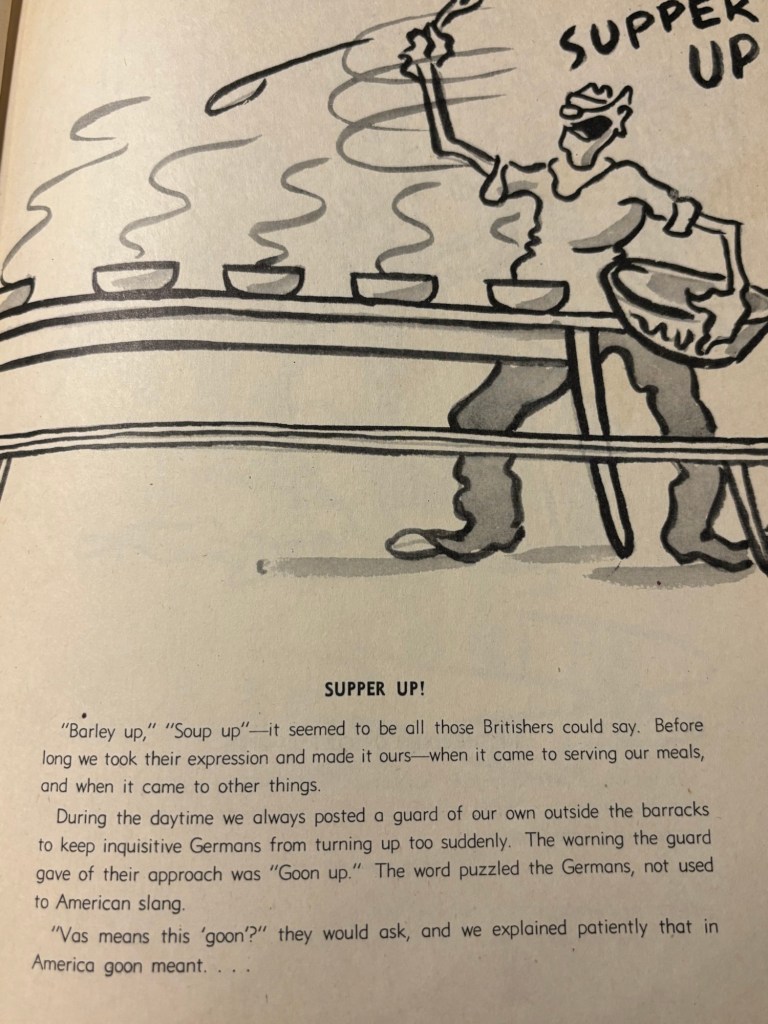
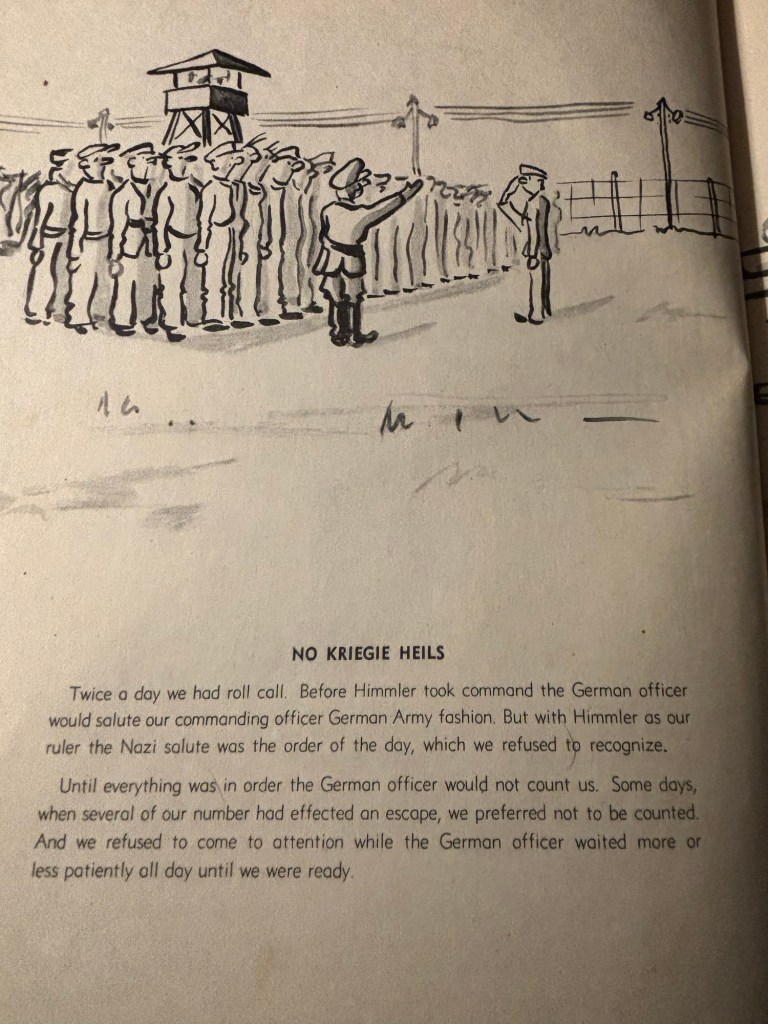
Cartoons from the book Welcome to POW Camp, which I mentioned in previous posts, bear this out.

A famous story, one my Daddy told us, from Stalag Luft 1: the day they finished the tunnel, climbed out, and found German soldiers waiting for them. Somehow they knew.

These cartoons provide a bit of insight into what life was like in the prison.

Solitary confinement was used to punish the POWs for trying to escape or being offensive to the guards.
Daddy would never eat sauer kraut or rutabaga, as I recall. Mom said it was because that was all he had to eat in POW camp. She said he only weighed 90 pounds when he got home.
Despite the harsh treatment and dangers, the POWs continued to resist the Nazi demands to “seig Heil” or salute Hitler while in the camp.

Probably the dominant thing that I remember from my Daddy’s few comments about the war and his POW time was his strong belief that the sacrifice and the discomfort were all worth it, because the dangers of Hitler’s Nazi assault on the world demanded that Americans step up and join the Allies to defeat him.

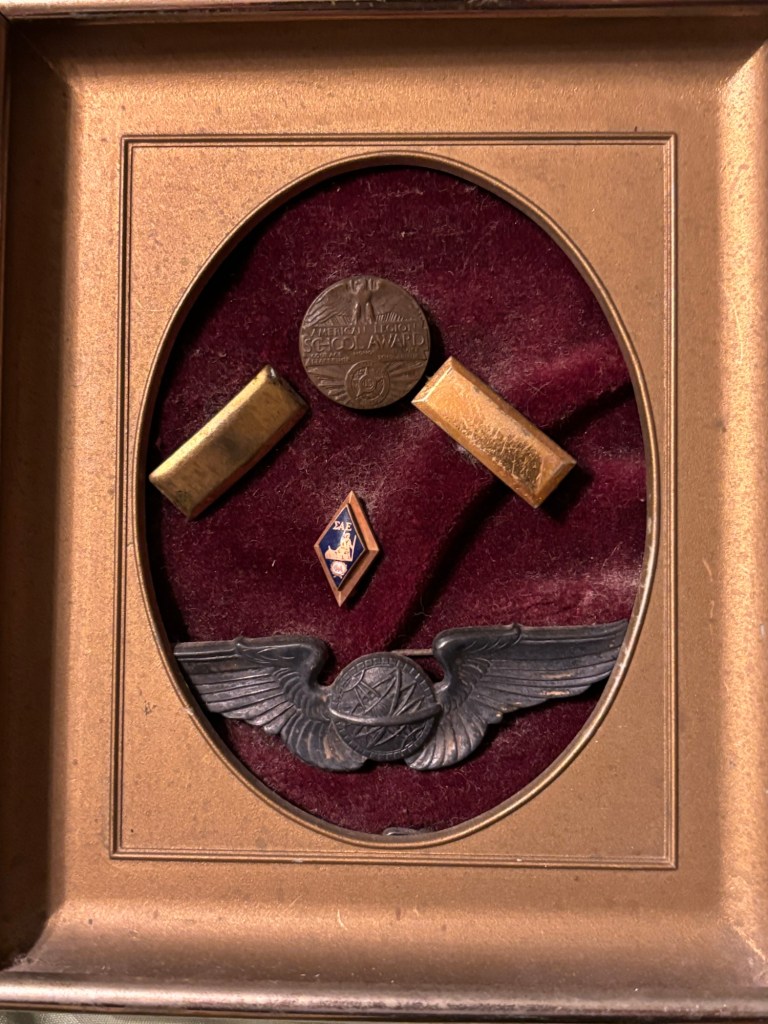
Daddy’s wings and lieutenant bars, plus a few other pins Mom saved.

Daddy was awarded an Air Medal, American Defense Service Medal, and the EAME Theater Ribbon with a battle star for his service. As far as I know, he never displayed those or talked about them. I only discovered this list of medals recently when I found his discharge orders in some things of his that I’ve had for years.

The whole experience left him proud and dedicated to his life as a newspaper man, spreading truth in the world. It must have had serious effects on his health, as his heart started to go in his 50s, and at 66 he died following bypass surgery.

He was as good a man as has ever walked this earth, and he was equally kind and generous to everyone, regardless of their status. All of us, his children, have struggled to live up to the high standards he set.

And we still love, honor and miss him these 39 years later.

Captured

(This is the third in a series of posts on my dad’s experience as a prisoner of war in World War II. They are in the category Dad as POW.)

As he floated down to earth under his parachute, watching the B-24 he had just bailed out of burn and crash, my dad, J. Fred Eden III, decided he needed to discover what his purpose in life was. He was convinced that he had been saved from the explosion by God, and that God thus must have some purpose in mind for him.

But he was to have a lot of time to meditate on what that purpose was over the next year. He descended to the ground in the countryside near the German town of Freden – which he always found to be another indication that his presence there was no accident, as the name was his name condensed into one word.

The story of his capture is one of the few things that he repeated to us enough times that it’s pretty clear in my mind. It happened sometime in early 1944 I think, and it was certainly a dramatic moment. He was seen by the local Germans as an enemy and an attacker of their cities, and thus not welcome.

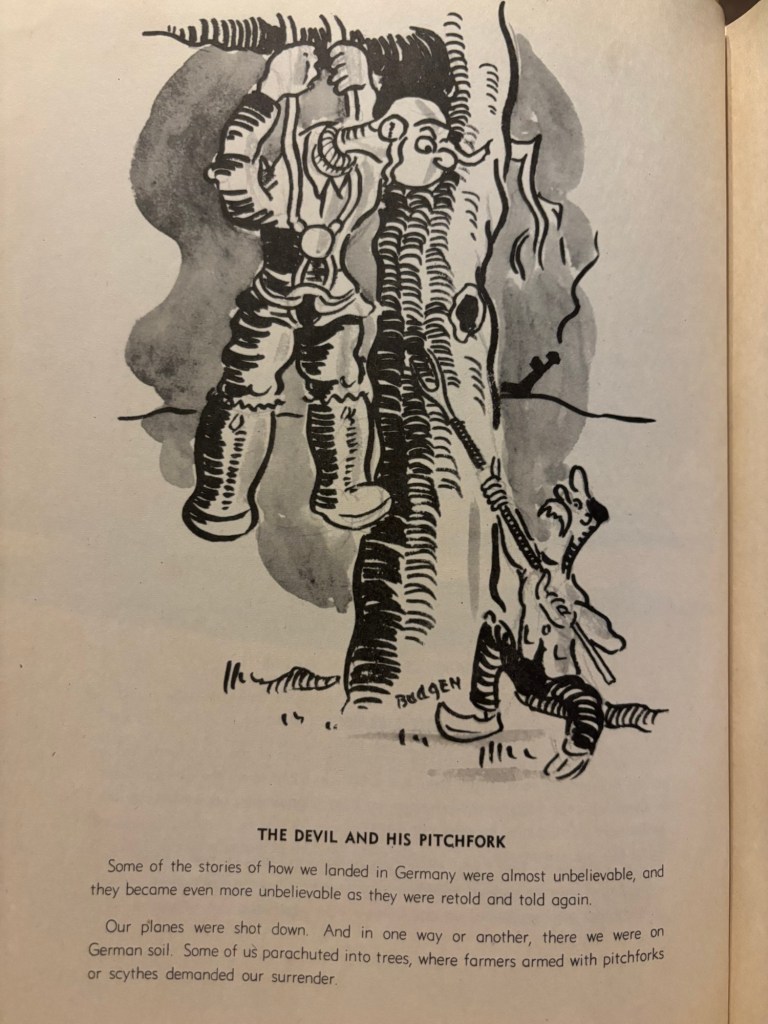
It was a rural town, so there were no soldiers on hand to rush out and capture the enemies falling from the sky, but the local farmers came out in droves, pitchforks in hand, to capture them. Daddy was surrounded and searched, and one of the frightened farmers found a pistol (I think it was a .45 automatic that all air crew members carried) in a pocket of his flight suit.

The excited farmer immediately pointed the weapon at him and tried to shoot him. Unfamiliar with the operation of the weapon, he didn’t know how to chamber a round and take off the safety, so, luckily for my dad and all of us descendants, he was unable to fire it.

Frustrated, the farmer threw the weapon to the ground and shouted in disdain, “Dum-dum! Dum-dum!” Apparently he thought it was a fake weapon.

A cartoon showing one way Kriegies were captured by the Krauts. This is from the book Welcome to POW Camp, and was drawn by Flt. Sgt. Budgen of the RAF, a POW at Stalag Luft Ein.

Daddy was then marched off to town by the contingent of pitchfork-armed farmers, and held by the local gendarmes until soldiers arrived to transport him to the “stalag luft” – the term for prisoner-of-war camps run by the German Nazi luftwaffe, or air force.

He was transported by train, as I recall the story, to the north of Germany near Barth. He spent the next 15 months in Stalag Luft Ein as a “kriegie” – the prisoners’ name for themselves that came from the German word “Kriegesgefangenen” – prisoner of war.

(Next up, life in Stalag Luft Ein.)

Welcome to POW Camp, Stalag Luft 1, Barth, Germany

was published by Edward’s & Broughton Company, Raleigh, NC.

No publication date is given.

The introduction says that there were 8,000 American Air Force prisoners of war in the German camp.

Among them were aces Col. Hubert Zemke (who shot down 28 German planes in air battles), Lt. Col. Gabreski and Major Beason.

RAF, Belgian, Russian and other Air Force personnel were also imprisoned there, according to the introduction.

AnnaJune Fall 23

The children

Summer-Fall 2023…

Me and June

Well, it’s been me and June a lot since the beginning of the summer. She’s spending lots of time with me, tho Mommy’s not here much, and we’re getting on well. Her birthday was fun, and she’s very proud to be five — tells everyone she meets that she’s five.

And boy is she five! She has such expanded ideas about things these days, and it has been very interesting and sweet watching her learn about a wide variety of things since she started kindergarten. She has a great kindergarten teacher, Mary Frye, and she usually is very excited about going to school, tho as the year is progressing, she is getting less eager to go.

She’s also just generally expanding her awareness of life — sometimes it’s disturbing, as she has said to me several times that she doesn’t want me to die. She was also playing pretend about someone dying and asked me frequently about my brother Bob’s death. Gene’s death (June 27) has been very hard on her, as well as on me. I think the reality of Taylor’s mom’s early death and these two uncles dying has made her especially sensitive and aware of the subject of death.

I wrote in my journal soon after Gene’s death, “I guess June keeps me going. She’s very loving, though stubborn, and so aware. She asked me yesterday if I was going to die in a long time or a short time. I told her I didn’t know, that no one knows. Gene’s death is a big factor in that, I guess. We tried to prepare them both, but kids don’t really understand. Just that someone’s gone.

“I do worry about her dealing with my death, but I think she will be okay. She’s strong and very self-reliant. I just hope she remembers how much I love her!”

We got a kitty and she is crazy for that cat! She doesn’t really know how to be nice to it, tho. Just treats it like it is a stuffed animal. Luckily, the cat is very tolerant!

June and I rode to St. Simons together to visit with Linda and John, and Stewart and Julian showed up with the little one, Charolette! June loved being with everyone!

She would really much prefer we were all together, so this back and forth life is hard on her. She’s with me about four days a week, usually, and then sometimes more, as Taylor stays over occasionally.

Taylor texted me one day to say, as part of a long and involved message, that “Anna June says she has the best Daddy in the world. And she’s so proud of you…” That meant a lot to ole Dad!

One of the most amazing things she’s said to me lately was about black holes, which I included in Little Johnny V – I had told her a story about crashing on my bike as a kid, and she said, well, you have to careful not to fall into a black hole because they suck up everything that falls into them!

I was astounded and asked her further, discovering that she had learned about them from some YouTube thing, but she didn’t realize there were not any on the Earth. So we talked further. Then she asked me, “But where do things go when they fall into a black hole?”

I said, when I got over being amazed, that no one knows the answer to that and lots of scientists are trying to figure it out.

The list of amazing things she says has gone beyond keeping up with it! And she’s doing so well in Kindergarten! She was in the paper twice for being in the student’s of the month for the Leaders in Me program, and her diagnostics are really good for the first half of the year. She can read lots of stuff and is very into learning more reading as well as the phonics. She enjoys seeing the words in the stories that she almost knows by heart and realizing that it’s the word that says… whatever it is. And she loves sounding out the words she doesn’t know.

Her math skills are pretty amazing too! She can “subatize” so well! (I just learned that term, which means recognize how many things are in a group without counting… something like that.)

She loves playing dice, and I think it helps her math awareness.

Little Johnny II

Little Johnny Stories — As told to June by her dad (that’s me!)

“Little Johnny and his Magic Daddy”

Once upon a time when Little Johnny was about 5, he had a painful thing happen, but his Daddy helped him get through it.

Johnny was trying to build a little house in the back yard of their new house in Valdosta, so he was finding things around the yard to stack up. He found an old concrete block in some bushes at the back of the yard, so he decided to add that to his stack. It was heavy, but he managed to get his arm through it and pick it up. He was struggling along headed for his little house, but he got tired and it slipped out of his arms and landed, smash!, right on his toe!

Aiiee! He cried out and headed for the back door. By the time he got inside, he was crying, and his Mommy came out of the kitchen asking him what happened.

He told her about the block, and showed her his toe, which was bleeding a little and looking pretty banged up.

“Oh! Poor little boy! I’m so sorry!” Mommy said. “Let’s get that fixed up!”

So Mommy put some medicine on his toe and a nice big bandaid, and gave him some water. He was still crying a little and his toe was really hurting when his Daddy came home from work a few minutes later.

“Oh no!” Daddy said when he heard the story. “I bet I can make that toe stop hurting!”

So Daddy showed Johnny his “magic jewel” — a pretty red piece of glass that he got down from a shelf. He gave the glass to Johnny to hold, and told Johnny to squeeze it and then give it back to him. Then he told Johnny he was going to make the jewel disappear.

Daddy put the jewel is his hands and moved them around really fast, put them behind his back and then held his hands out in front of Johnny — and there was no jewel! Johnny was amazed. Then Daddy asked him where he thought the jewel was. When Johnny said he didn’t know, Daddy said, “I bet it’s in your ear!”

We’ll, Johnny didn’t believe that, and he laughed, “No!”

But then Daddy held his hand out and reached up to first one ear and then the other, and then he flashed his hand open in front of Johnny and there it was! The jewel was sitting in Daddy’s hand!

“Hey! How’d you do that!” he asked.

“Magic!” Daddy said!

By then, of course, Johnny had forgotten all about his injured toe, and though it still hurt, he felt so much better about the whole situation that he stopped crying, and he and Daddy had a fun time together talking about magic tricks and all kinda of interesting things!

Daddy – and back to Georgia

[This is Chap. 16 in the continuing narrative on My Way-finding. Previous chapters are Pages on this site, and links can be found in the menu to the left of the main entry.]

My daddy had a powerful influence on my life.

He was one of those larger-than-life characters who made an indelible impression on everyone, and he shaped me in ways that I’ve only recently begun to understand, though I’ve now outlived him by over a year. He was a tall, handsome man with a personal warmth and a charismatic speaking style that made him the best preacher I ever heard, though he wasn’t a preacher, he was a journalist.

His father and grandfather had both been Baptist preachers, active in the Georgia Baptist Convention and Mercer University, the Baptist college, but Daddy chose a different pulpit: a small-town weekly newspaper. He was a solid Baptist his whole life, and could fill any pulpit with a wonderful sermon, and he raised all of us to be dutiful Baptists as well. I was pretty much into that role until sometime in high school, and college broke me completely out of it (as I’ve related in earlier posts), but that never really came between us at the emotional level.

For much of my young life, I wanted to be him, but Vietnam – and all of the Vietnam era radicalism that I embraced – came between us in a big way. He had been a navigator on B-24’s in World War II, flying out of England in the storied raids on Hitler’s ball-bearing factories, and I became a war resister.

Well – first I joined the Air Force and became a pilot because I knew that would make him happy. But then I encountered the reality of the petty little empire-building escapade that we called, in our ignorance and arrogance, “the Vietnam War.” I went, despite my reticence, because I thought I really didn’t know what was going on there, going on in the world, going on in the exalted realms of the U.S. political system… so I should give up my foolish notions of knowing that it was all wrong and just go, like all the other people I knew who had gone and either died or come back.

And then I got there and found out it was every bit as depraved and stupid and immoral and deceptive and wrong as I had thought… and so after about nine months of it, I bailed. At least I tried to. I told them I wasn’t that into the war and wanted to be out of the Air Force.

They said, well, yes, but… no. You haven’t really done anything bad, you’ve played by the rules, been a good boy, so there’s no reason we should let you out before your commitment is up. So then I said, okay, fine, then I won’t do anything for you anymore. By then of course, I was back in the states and supposed to be an instructor, teaching guys to go there and do what I did for a year and ten days. (I was in country an extra ten days waiting for them to decide what to do with me, since I had an “administrative action pending”.)

It’s a long story, one I’ve related in my War Journal, which is on my website hoyama.org, but the upshot is, I finally got out. In the process of this, of course, my father and I had some serious, divisive, but inconclusive, discussions. He never really understood, though my mother supported me, and even after it was all over – my discharge, the war, the social debate – we never really talked about it at the level that we should have.

And then he died.

On his 66th birthday, really in the prime of his life, while I was living in Oregon, he went into heart bypass surgery and never regained consciousness. We rushed back to Georgia when they decided he needed the surgery, but he was still on the machine when we arrived, and his heart would never resume its work on its own, so he died as I stood in the intensive care ward watching him breathe and listening to the machines beep.

….

I was totally unprepared for the loss, and it flattened me.

I was pretty much lost in grief for some time, but eventually I repressed most of it and went back to my ignorance and denial. But it dug a hole in me that began to fester. All those unsaid things began to eat away my insides, All the regret and guilt of a lifetime eventually ate away my heart and my gut and replaced them with balls of molten metal.

About a year after Daddy’s death, Giana and Luke and I moved back to Georgia to be with my mom. She had been left pretty much alone when Daddy died, and though she was a strong and independent woman in many ways, the solitary life didn’t suit her. She needed family around, so we came.

Moving back to Georgia, I figured any hope of ever finding a Buddhist group to be part of was over. It was Georgia, the heart of Baptist-land. But I brought my Buddha-rupa, my carving, and set up a low-key altar in my house. I continued to think of myself as a Buddhist and read books about Buddhism.

And those balls of hot iron continued to grow inside me. I continued to descend into depression in longer and deeper spirals. I had never figured out that I needed to meditate on a regular basis. It seemed more like an exotic delicacy to be tasted at random, when in fact it’s as necessary as daily bread. So I suffered, and I visited that suffering on all those around me.

….

And then one day, our friend Claire came home from a weekend in Atlanta and told me about this wonderful thing she had found: a Zen center.