(This is the third in a series of posts on my dad’s experience as a prisoner of war in World War II. They are in the category Dad as POW.)
As he floated down to earth under his parachute, watching the B-24 he had just bailed out of burn and crash, my dad, J. Fred Eden III, decided he needed to discover what his purpose in life was. He was convinced that he had been saved from the explosion by God, and that God thus must have some purpose in mind for him.
But he was to have a lot of time to meditate on what that purpose was over the next year. He descended to the ground in the countryside near the German town of Freden – which he always found to be another indication that his presence there was no accident, as the name was his name condensed into one word.
The story of his capture is one of the few things that he repeated to us enough times that it’s pretty clear in my mind. It happened sometime in early 1944 I think, and it was certainly a dramatic moment. He was seen by the local Germans as an enemy and an attacker of their cities, and thus not welcome.
It was a rural town, so there were no soldiers on hand to rush out and capture the enemies falling from the sky, but the local farmers came out in droves, pitchforks in hand, to capture them. Daddy was surrounded and searched, and one of the frightened farmers found a pistol (I think it was a .45 automatic that all air crew members carried) in a pocket of his flight suit.
The excited farmer immediately pointed the weapon at him and tried to shoot him. Unfamiliar with the operation of the weapon, he didn’t know how to chamber a round and take off the safety, so, luckily for my dad and all of us descendants, he was unable to fire it.
Frustrated, the farmer threw the weapon to the ground and shouted in disdain, “Dum-dum! Dum-dum!” Apparently he thought it was a fake weapon.
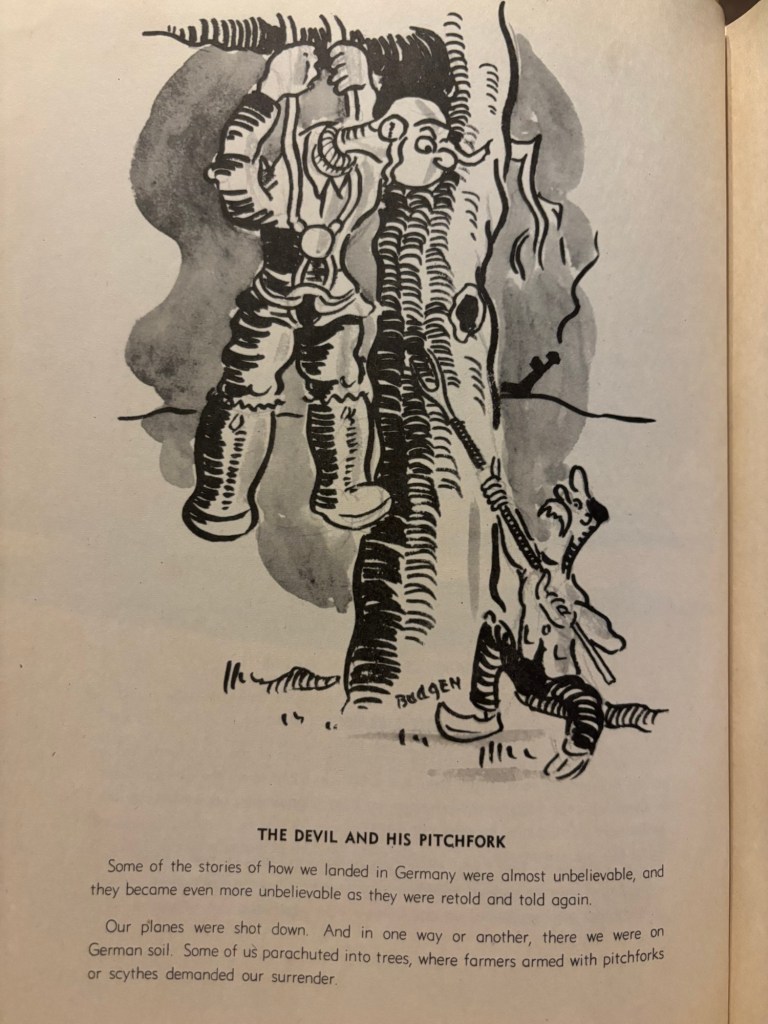
Daddy was then marched off to town by the contingent of pitchfork-armed farmers, and held by the local gendarmes until soldiers arrived to transport him to the “stalag luft” – the term for prisoner-of-war camps run by the German Nazi luftwaffe, or air force.
He was transported by train, as I recall the story, to the north of Germany near Barth. He spent the next 15 months in Stalag Luft Ein as a “kriegie” – the prisoners’ name for themselves that came from the German word “Kriegesgefangenen” – prisoner of war.
(Next up, life in Stalag Luft Ein.)
Welcome to POW Camp, Stalag Luft 1, Barth, Germany
was published by Edward’s & Broughton Company, Raleigh, NC.
No publication date is given.
The introduction says that there were 8,000 American Air Force prisoners of war in the German camp.
Among them were aces Col. Hubert Zemke (who shot down 28 German planes in air battles), Lt. Col. Gabreski and Major Beason.
RAF, Belgian, Russian and other Air Force personnel were also imprisoned there, according to the introduction.
 Shunyata's Apprentice